



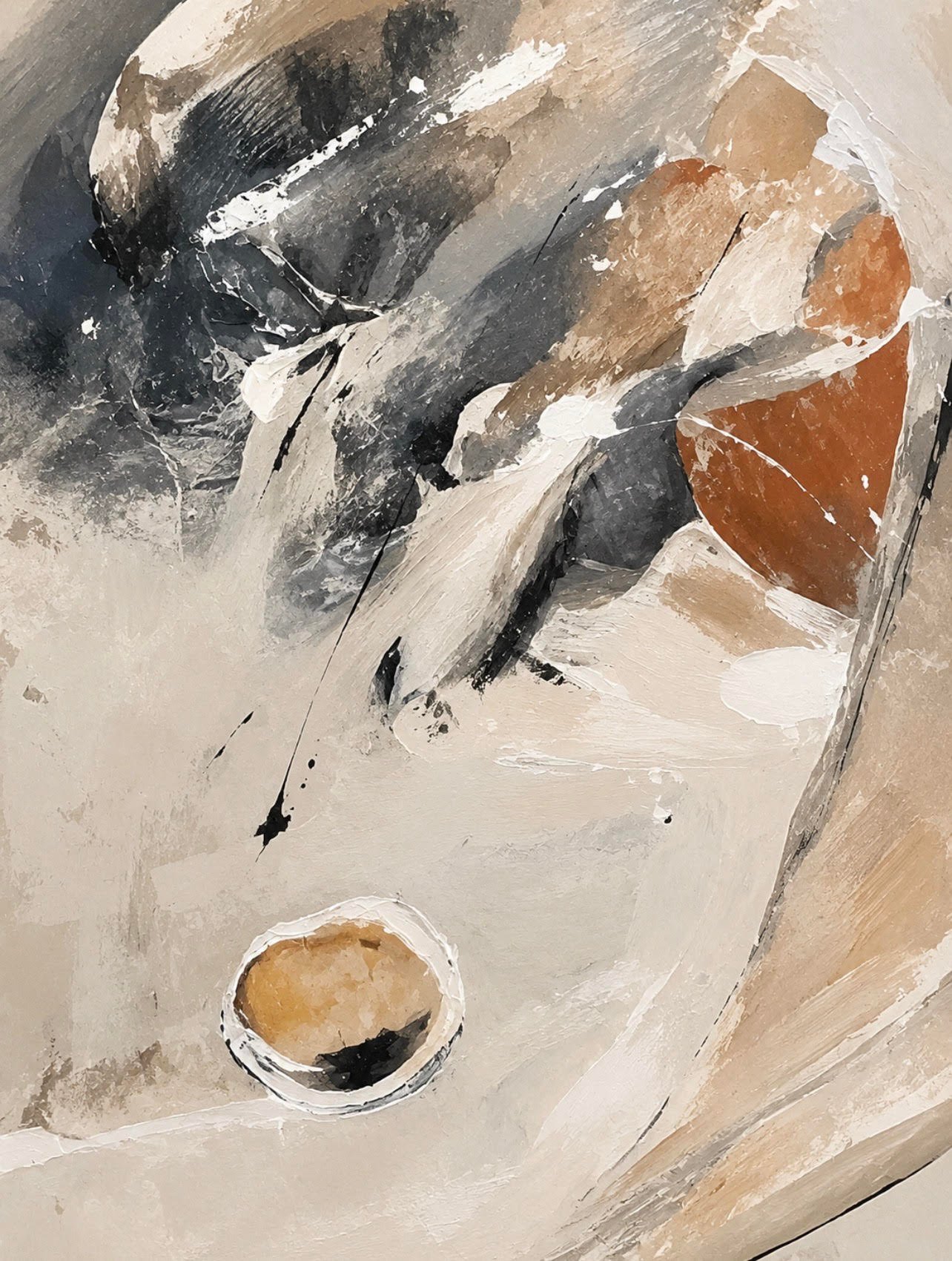
Art does not always need to show people, landscapes, or objects to communicate an idea. Sometimes a collection of colors, textures, and shapes can express emotions more deeply than a realistic image. This abstract painting is an example of visual storytelling that speaks through atmosphere rather than direct representation. Every mark on the canvas contributes to a mood that encourages reflection and personal interpretation.
At first glance, the artwork appears to be a blend of soft neutral tones interrupted by darker forms and warm earthy accents. There is no obvious subject, yet the composition feels alive. The viewer’s attention naturally moves across the surface, exploring different areas and discovering new details. This movement creates a sense of curiosity, making the painting feel dynamic rather than static.
The pale background dominates much of the composition. White and cream shades often symbolize openness, purity, and possibility. In this context, they create a spacious environment where thoughts can wander freely. The lighter sections provide visual breathing room and give the artwork a calm foundation. These areas may represent silence, inner peace, or moments of stillness that exist between life’s many events.
Contrasting with the light tones are bold strokes of gray and black. These darker elements introduce tension and depth. They suggest experiences that carry weight and significance. Every person’s life contains challenges, uncertainties, and difficult decisions. The dark passages within the painting can be viewed as symbols of those experiences. Rather than overwhelming the composition, they add character and complexity, reminding us that growth often emerges from adversity.
The warm brown and terracotta shapes bring another layer of meaning. Earthy colors are frequently associated with stability, grounding, and connection to nature. Their presence introduces warmth into the visual narrative. These forms appear solid compared to the more fluid brushwork surrounding them. As a result, they can be interpreted as anchors that provide support during periods of change.
Texture plays a powerful role throughout the artwork. Thick applications of paint create a tactile quality that invites closer examination. The layered surfaces suggest a history beneath the visible image. Just as human beings carry memories and experiences accumulated over time, the painting contains traces of previous gestures hidden within its structure. This depth gives the work a sense of authenticity and emotional richness.
The sweeping motions visible across the canvas create an impression of movement. Nothing appears rigid or confined. Instead, the composition flows naturally from one area to another. This visual rhythm can symbolize the continuous nature of life itself. Circumstances evolve, perspectives shift, and individuals transform as they move through different stages of existence. The painting captures that ongoing process without defining a specific destination.
One particularly intriguing element is the circular shape located near the lower portion of the composition. Circles often carry symbolic significance across cultures and traditions. They may represent unity, wholeness, continuity, or potential. In this painting, the circular form stands apart from its surroundings, drawing attention without dominating the scene. It can be seen as a seed of possibility, a source of energy, or a reminder of the inner self that remains present throughout life’s changes.
The artwork also communicates through contrast. Soft areas exist beside rough textures. Bright regions meet darker passages. Delicate transitions appear alongside bold gestures. These opposites create balance within the composition. Such balance reflects the reality of human experience, where joy and sorrow, certainty and doubt, activity and rest often coexist.
Another fascinating aspect of abstract art is its ability to adapt to the viewer’s perspective. Two individuals may observe the same painting and discover entirely different meanings. One person might see resilience after a difficult period. Another might perceive creativity emerging from chaos. Someone else could interpret the work as a meditation on personal freedom. None of these interpretations are necessarily wrong because abstract art invites participation rather than providing fixed answers.
The absence of recognizable imagery allows emotions to take center stage. Without a specific narrative directing attention, viewers are encouraged to connect with their own thoughts and memories. This personal engagement transforms the experience from simple observation into meaningful reflection. The painting becomes a conversation between the artwork and the individual looking at it.
From a modern artistic perspective, the composition demonstrates confidence in simplicity. It does not rely on excessive detail to make an impact. Instead, it uses carefully balanced forms, restrained color choices, and expressive textures to create emotional resonance. This approach reflects contemporary design principles that value clarity, authenticity, and thoughtful composition.
The painting may also be understood as a visual representation of transformation. Nothing appears fully defined or permanently fixed. Shapes seem to emerge, dissolve, and reappear across the surface. This quality mirrors the evolving nature of identity and experience. People constantly learn, adapt, and discover new aspects of themselves. The artwork captures that fluid process through its layered and organic structure.
There is also a sense of mystery embedded within the composition. Certain areas feel partially revealed while others remain hidden. This ambiguity encourages prolonged viewing because the eye continues searching for connections and meaning. The painting rewards patience, offering new impressions each time it is examined.
Ultimately, this artwork speaks about the beauty of exploration. It reminds viewers that meaning is not always obvious and that uncertainty can be valuable. Through its harmonious combination of light, shadow, texture, and movement, the painting creates an emotional landscape that feels both personal and universal. It encourages contemplation, celebrates transformation, and honors the complexity of human experience. Rather than presenting a single message, it opens a doorway to countless interpretations, allowing every observer to discover something unique within its abstract world.
– Written and Published by Gaurav Bhama