


A Life Journey from Childhood to Old Age
Life does not teach us everything at once. Different stages of life bring different experiences, different challenges and different lessons.
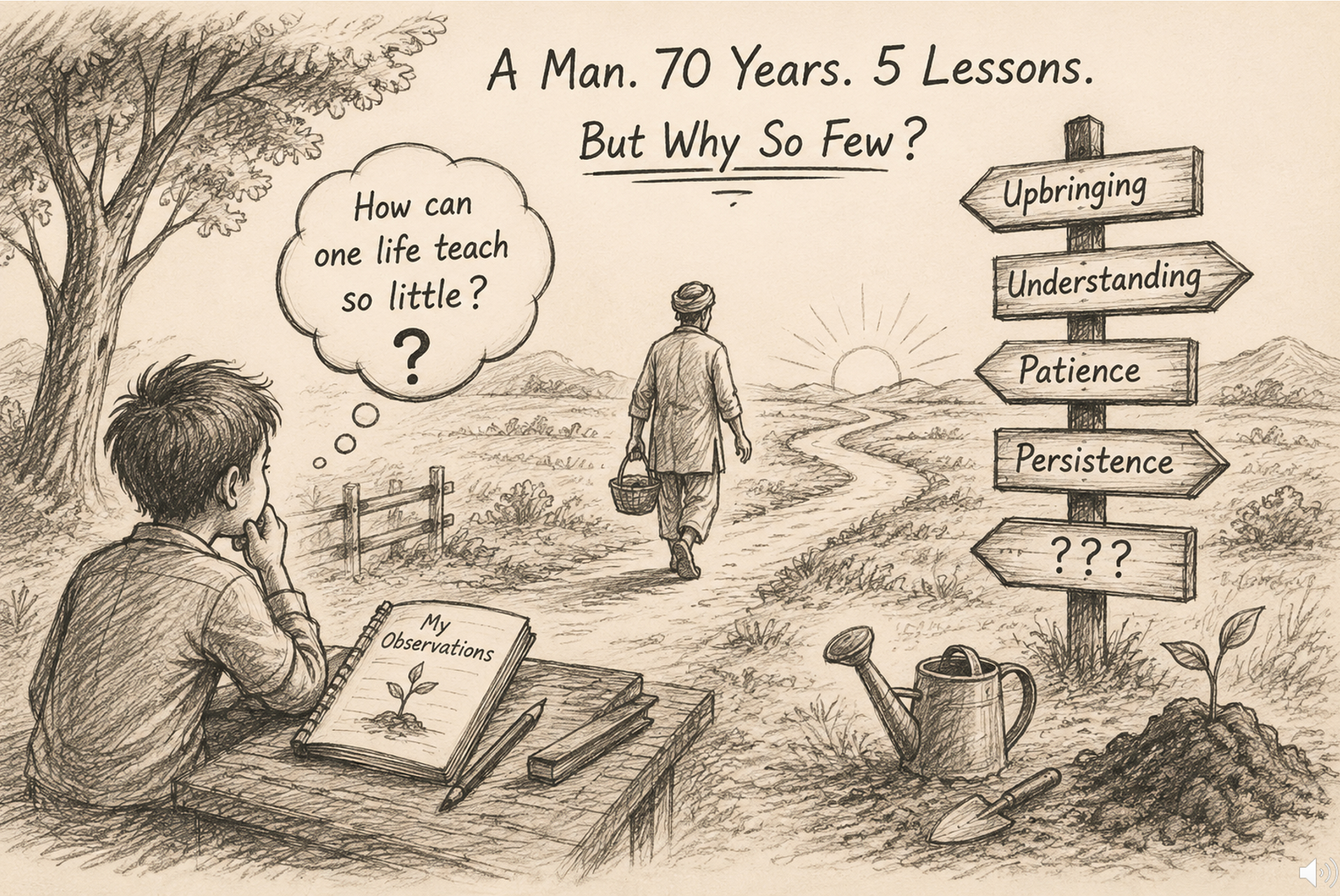
Seed of Observation follows one man’s journey through five important stages of life, where every seed becomes a metaphor for a lesson he learns along the way.
Age 0–12 → Fenugreek → Upbringing
Age 18 → Coconut → Understanding & Adaptability
Age 30 → Bamboo → Patience
Age 50 → Watermelon → Persistence
Age 70 → Final Harvest → Togetherness
The journey begins with “I” and eventually teaches him the importance of “We.”
🌱 Age 0–12: The Fenugreek Seed – The Foundation of Upbringing
When he was a little boy, he often watched his parents working in the fields.
He observed his father preparing the soil and his mother carefully sowing fenugreek seeds.
He noticed that they never simply threw the seeds into the ground.
First, they prepared the soil.
Then they added manure.
They made sure there was enough water, but not too much.
They understood that every small detail mattered.
The boy watched silently.
He began to understand something that went far beyond farming.
A seed does not grow simply because it is placed in the soil.
It needs the right environment, nourishment, care and balance.
And perhaps a child is not very different.
A child is also a seed.
Parents, teachers, elders, surroundings, values, habits and experiences become the soil in which that child grows.
The boy quietly absorbed this lesson from his parents:
“The way a seed is nurtured determines how it grows. The same is true for a human being.”
He did not know it then, but this observation would remain with him throughout his life.
Lesson of Age 0–12
Upbringing gives us our roots.
The values and behaviours we observe during childhood often become the foundation on which we build the rest of our lives.
🥥 Age 18: The Coconut Seed – Understanding and Adaptability
Years passed.
The boy became eighteen.
Life took him away from his childhood home. He moved to a new place after marriage, surrounded by new people, new circumstances and a completely different environment.
But he carried one strong memory with him.
He remembered how his parents had grown fenugreek.
One day, he wanted to grow the same crop.
He searched for fenugreek seeds.
But there were none.
Eventually, someone gave him a coconut seed.
“Plant this,” they told him. “It will give you shade, fruit and sweetness.”
He looked at the seed and thought:
“A seed is a seed. I already know how to grow one.”
Without asking questions, he followed the method he had learned as a child.
He prepared the soil.
Added manure.
Added water.
And planted the coconut seed.
Then he waited.
Nothing happened.
Days passed.
Then weeks.
Still nothing.
Slowly, he understood something important.
His parents had not simply taught him how to plant a seed.
They had taught him how to observe and care.
Every seed is different.
Every environment is different.
Every situation is different.
What works for fenugreek may not work for coconut.
And what worked yesterday may not work today.
Life is exactly the same.
The lessons we receive from our parents and past experiences are valuable, but they cannot always be copied exactly into new situations.
We must understand the situation before applying the lesson.
Lesson of Age 18
Upbringing gives us a foundation, but understanding teaches us how to adapt.
The question he learned to ask was:
“What does this situation need?”
🎋 Age 30: The Bamboo Seed – The Power of Patience
By the time he reached thirty, he had already learned two important lessons.
From his parents, he had learned nurturing.
From the coconut, he had learned understanding and adaptability.
Then life presented him with another opportunity.
A bamboo seed.
This time he thought:
“I will not repeat my mistake. First, I will understand.”
He studied the soil.
He considered water.
He looked at sunlight.
He carefully planted the seed.
And then he waited.
A week passed.
Nothing.
A month passed.
Nothing.
A year passed.
Still nothing.
Eventually, frustration took over.
He thought:
“I have learned. I have understood. I have done everything correctly. Why is there still no result?”
He became impatient.
One day, he destroyed the patch of soil.
He gave up.
Later, he learned something that broke his heart.
Bamboo can spend a long period developing its root system before significant growth becomes visible above the ground.
What appears to be “nothing happening” may actually be a period of tremendous preparation.
The growth was happening.
He simply could not see it.
Sometimes we judge progress only by what is visible.
But skills grow silently.
Character grows silently.
Relationships grow silently.
Experience grows silently.
And sometimes success itself is building its roots before it becomes visible.
He realised:
“I did not fail because I lacked knowledge. I failed because I could not wait long enough to see the result.”
Lesson of Age 30
Patience is the bridge between effort and visible growth.
Not every seed is meant to sprout immediately.
Do not destroy your progress simply because you cannot yet see the result.
🍉 Age 50: The Watermelon Seed – Persistence Through Experience
At fifty, the man had become much wiser.
His life had taught him three important lessons:
Upbringing.
Understanding.
Patience.
Now he believed he was finally ready.
He planted watermelon seeds.
This time, he prepared the soil carefully.
He provided water and nourishment.
He watched the vines spread.
The plants grew beautifully.
But then something went wrong.
The vines grew.
The leaves became healthy.
Yet the fruits did not hold.
The small watermelons appeared but failed to mature.
He was devastated.
After everything he had learned, he still could not complete the harvest.
Then he realised that he had forgotten an important requirement in his cultivation process.
It was not a lack of knowledge.
It was forgetfulness.
Experience alone does not guarantee success.
Sometimes we know what to do but fail to remember it at the right time.
Sometimes we understand the solution but fail to apply it.
Sometimes we are close to success but stop too early.
Instead of giving up, he tried again.
He remembered what was missing and applied the necessary treatment at the appropriate stage.
Slowly, the plants began to hold fruit.
Eventually, large, ripe watermelons appeared.
He stood in the field looking at them with tears in his eyes.
Not because the watermelon was extraordinary.
But because it represented fifty years of learning.
He finally understood:
Success is rarely the result of one perfect attempt.
It is often the result of learning, failing, correcting, remembering, trying again and continuing.
Lesson of Age 50
Experience helps us, but persistence completes the journey.
Even when we forget.
Even when we make mistakes.
Even when progress is delayed.
We can still return, correct our course and continue.
A delayed harvest is not necessarily a failed harvest.
🌾 Age 70: The Final Harvest – The Lesson of Togetherness
At seventy, the man looked at his field.
The watermelons were finally ripe.
Heavy.
Healthy.
Ready to harvest.
He smiled.
After decades of learning, struggling, failing, waiting and trying again, the moment had finally arrived.
He thought:
“At last, I will enjoy the fruits of my life’s work.”
He walked into the field to harvest them.
But his body was no longer the body of the young boy who had once watched his parents work.
His strength had faded.
His body failed him.
And before he could enjoy the harvest, his life came to an end.
When he reached heaven, he looked at God with tears in his eyes.
He asked:
“Why?”
“I learned how to nurture.”
“I learned how to understand.”
“I learned patience.”
“I learned persistence.”
“I finally grew the fruits I had worked for all my life.”
“Then why did I never get to enjoy them?”
God looked at him gently and replied:
“You learned everything about the seed, but you forgot something about life.”
“You lived in ‘I.’”
“You relied on your own hands, your own memory, your own knowledge and your own experience.”
“You walked alone.”
“If you had built relationships along the way, someone could have reminded you when you forgot.”
“Someone could have helped when you became weak.”
“Someone could have harvested the fruits when your hands could no longer do it.”
“And someone could have sat beside you and enjoyed the harvest with you.”
The man finally understood.
His greatest mistake was believing that success was something one person had to achieve alone.
🤝 The Greatest Seed: Togetherness
A seed may begin its journey alone.
But nothing in nature truly exists in isolation.
The soil supports the seed.
Water supports the plant.
Sunlight supports growth.
Farmers nurture the crop.
People help each other.
Families share responsibilities.
Teams create possibilities that individuals cannot create alone.
And life works in much the same way.
Knowledge can make us capable.
Patience can make us stronger.
Persistence can help us continue.
But relationships give meaning to the journey.
Imagine achieving everything you wanted but having nobody to share it with.
Imagine building something meaningful but having nobody beside you.
Imagine growing a beautiful harvest but having nobody to help you bring it home.
What is the value of the harvest then?
The lesson is not that individual effort does not matter.
It matters enormously.
The lesson is that individual effort becomes more meaningful when it creates something that can be shared with others.
🌱 The Five Stages of Life
| Age | Life Stage | Seed | Core Lesson |
|---|---|---|---|
| 0–12 | Childhood | 🌱 Fenugreek | Upbringing |
| 18 | Youth | 🥥 Coconut | Understanding & Adaptability |
| 30 | Adulthood | 🎋 Bamboo | Patience |
| 50 | Maturity | 🍉 Watermelon | Persistence |
| 70 | Old Age | 🌾 Final Harvest | Togetherness |
The journey can be seen as:
Upbringing → Understanding → Patience → Persistence → Togetherness
Each stage prepares us for the next.
👶 Age 0–12: What Children Can Learn
Childhood is the stage of observation and foundation.
Children learn by watching.
Parents, teachers, grandparents and surroundings become their first environment.
They can learn to:
- Observe carefully.
- Ask questions.
- Build good habits.
- Learn from elders.
- Understand that small actions create long-term results.
- Value family and cooperation.
A child’s character is built from thousands of small observations.
🌿 Age 13–25: What Teenagers and Young Adults Can Learn
Young adulthood brings new environments, people and challenges.
What worked in one situation may not work in another.
Young people can learn to:
- Adapt to changing circumstances.
- Learn before acting.
- Seek guidance.
- Stay curious.
- Explore beyond their comfort zone.
- Be willing to unlearn and relearn.
The world changes. Wisdom is knowing when to change with it.
🎋 Age 26–40: What Adults Can Learn
This stage often brings ambition, responsibility and pressure.
Results become important, but not everything grows immediately.
Adults can learn to:
- Give important goals enough time.
- Avoid abandoning something simply because results are delayed.
- Build skills and relationships quietly.
- Understand that invisible progress is still progress.
- Stay patient.
Sometimes you are not failing. You are simply growing roots.
🍉 Age 41–60: What Midlife Can Teach Us
By middle age, experience becomes one of our greatest assets.
But experience does not mean we know everything.
Midlife can be a time to:
- Continue learning.
- Review what worked and what did not.
- Pay attention to small details.
- Correct mistakes without ego.
- Stay persistent.
- Share knowledge with younger people.
- Accept help from others.
Wisdom is not knowing everything. Wisdom is knowing that we can still learn.
🌺 Age 61+: What Seniors Can Teach Us
Later in life, success takes on a different meaning.
It becomes less about what we achieved and more about what we leave behind.
Seniors can focus on:
- Sharing experiences.
- Mentoring younger generations.
- Strengthening relationships.
- Building community.
- Passing knowledge forward.
- Creating a legacy beyond money and possessions.
Because eventually, the question is not:
“How much did I grow?”
It is:
“Who grew because I was part of their journey?”
🌳 The Real Meaning of Success
The story of Seed of Observation is not really about farming.
It is about life.
We begin as seeds.
Our parents provide the first soil.
Life gives us different environments.
Experience teaches us to adapt.
Challenges teach us patience.
Failure teaches us persistence.
And relationships teach us that we were never meant to walk completely alone.
Our journey may begin with “I.”
But perhaps its purpose is to eventually become “We.”
🌱 Final Thought
A seed does not know how tall it will become when it is first planted.
It simply begins.
It receives what it needs.
It survives difficult seasons.
It grows roots.
It reaches toward the light.
And eventually, it produces something that others can enjoy.
Perhaps life is the same.
Upbringing gives us roots.
Understanding gives us direction.
Patience gives us strength.
Persistence brings the harvest.
But togetherness gives the harvest meaning.
So observe.
Learn.
Adapt.
Wait.
Persist.
And most importantly, do not walk alone.
Because the greatest achievement in life may not be the fruit we grow.
It may be the people who stand beside us when the fruit finally ripens.
Seeds may grow in solitude, but fruits ripen in togetherness.
And perhaps that is the true Seed of Observation.