

Why choose a budget-friendly ERP when expensive ERPs are already available?
For years, ERP selection was largely about functionality.
Businesses compared ERP platforms based on features, modules, scalability, customization capabilities, industry coverage, implementation partners, and global presence.
This approach made sense when the ERP itself was considered the primary technology investment for running the business.
But the business technology landscape is changing.
Artificial Intelligence is changing what businesses expect from their ERP systems.
ERP is increasingly becoming the foundation on which AI, automation, integrations, analytics, and intelligent business processes are built.
This raises an important question:
If ERP is becoming the foundation for AI-driven automation, should businesses continue to invest disproportionately in the ERP itself, or should they invest more strategically in the automation and intelligence built on top of it?
This is where the discussion around Odoo vs SAP and other large enterprise ERPs becomes interesting.
ERP Is No Longer the Final Destination
Traditionally, ERP was expected to do almost everything.
Users would log into the ERP, enter transactions, create reports, monitor workflows, approve documents, check inventory, manage production, follow up on receivables, and make business decisions.
The ERP was both the system of record and the primary system of interaction.
AI is changing this model.
The emerging architecture looks more like:
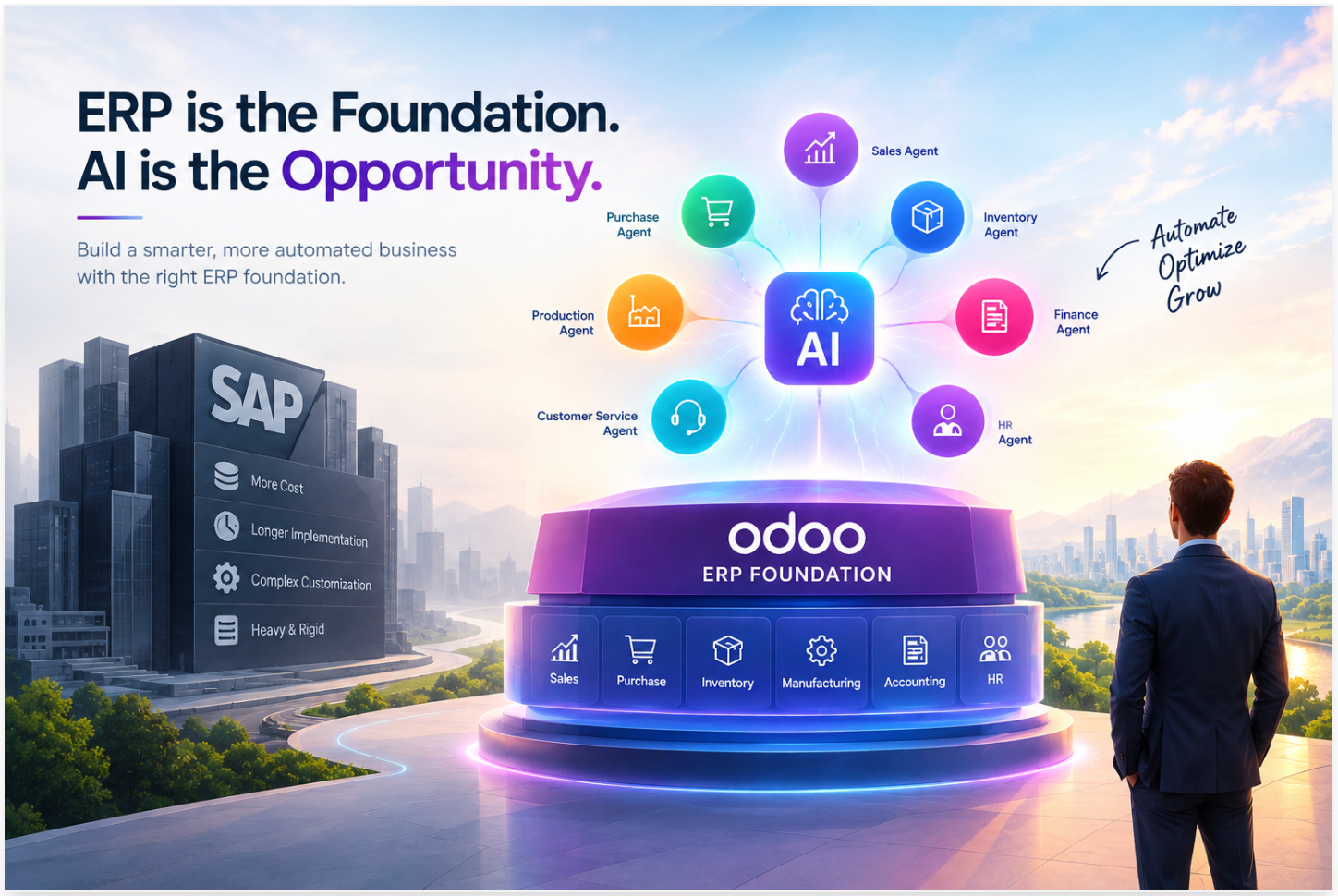
ERP → Business Data → Integrations → AI Agents → Automation → Business Decisions
The ERP remains extremely important.
But it increasingly becomes the business foundation, while AI provides an additional layer of intelligence and automation.
The Role of ERP Is Changing
A modern business may still need ERP for:
- Sales
- CRM
- Purchasing
- Inventory
- Manufacturing
- Accounting
- Projects
- Human Resources
- Quality
- Supply Chain
- Customer Management
But businesses increasingly want something beyond recording transactions.
They want systems that can answer questions, identify problems, recommend actions, automate repetitive activities, and support decision-making.
For example:
Instead of a purchase manager manually checking stock levels, open purchase orders, supplier lead times, and consumption patterns, an AI agent could analyze the information and highlight potential shortages.
Instead of a sales manager manually reviewing hundreds of opportunities, an AI agent could identify deals requiring attention.
Instead of management waiting for reports, an AI interface could answer questions such as:
“Which customers have outstanding payments beyond our normal credit period?”
“Which products are likely to face a stock shortage next month?”
“Which orders are currently at risk of missing their delivery commitment?”
“Which production orders are consuming more material than expected?”
The ERP provides the underlying data.
AI provides the intelligence layer.
Why Spend More on the ERP Foundation?
This does not mean that expensive ERP systems are unnecessary.
Large enterprise platforms can provide significant value for organizations with complex global operations, highly structured governance, sophisticated supply chains, regulatory requirements, large user populations, and extensive enterprise processes.
The question is not:
“Is SAP expensive?”
The better question is:
“Does the additional investment in a heavy ERP create enough business value for my organization?”
For a large multinational enterprise, the answer may be different from that of a growing manufacturing company, distributor, engineering company, healthcare organization, or services business.
For many small and mid-sized businesses, ERP investment needs to be considered in terms of:
- Total implementation cost
- License cost
- Customization cost
- Maintenance cost
- Upgrade cost
- User adoption
- Implementation timeline
- Integration requirements
- Future automation
- Return on investment
And this is where a more flexible ERP platform can become attractive.
Odoo vs SAP: A Different Way to Look at the Comparison
The traditional comparison is often:
Odoo vs SAP
Which ERP has more functionality?
Which has more modules?
Which has more enterprise features?
Which has a larger ecosystem?
But the AI era introduces another dimension.
Instead of looking only at the ERP platform itself, businesses should consider the complete technology architecture:
ERP Foundation
The ERP manages the core business processes and maintains structured business data.
Integration Layer
The ERP connects with e-commerce platforms, payment gateways, logistics systems, banks, CRM systems, production equipment, portals, and other applications.
AI Layer
AI agents analyze business information, interact with users, identify exceptions, generate insights, and support decisions.
Automation Layer
AI and workflow automation can execute repetitive activities according to defined rules, approvals, permissions, and business objectives.
This creates a very different technology model.
The ERP does not have to do everything itself.
It needs to provide a strong and accessible foundation for everything built around it.
Odoo as an ERP Foundation for AI Automation
Odoo is particularly interesting in this context because it brings together a broad range of business applications in a relatively integrated platform.
A business can use Odoo for its core operations and then build additional automation and intelligence around its data and workflows.
For example:
| Business Function | ERP Foundation | Potential AI Agent |
|---|---|---|
| Sales | CRM, quotations, orders | Sales Agent |
| Purchase | RFQs, purchase orders, vendors | Procurement Agent |
| Inventory | Stock, warehouses, movements | Inventory Agent |
| Manufacturing | BOM, MRP, work orders | Production Agent |
| Finance | Invoices, payments, receivables | Finance Agent |
| Projects | Tasks, timesheets, milestones | Project Agent |
| Customer Service | Tickets and customer history | Customer Service Agent |
| Management | Reports and dashboards | Management Agent |
The objective is not to replace the ERP.
The objective is to make the ERP more intelligent and reduce the amount of manual work required around it.
From ERP Users to AI-Assisted Business Operations
One of the biggest opportunities is the evolution of the traditional ERP user.
Today:
User → ERP → Data Entry → Report → Decision
The emerging model can become:
User → AI Agent → ERP Data → Analysis → Recommendation → Action
For example, a CXO may not need to navigate multiple screens to understand the business.
They could ask:
“What are the three biggest operational risks this week?”
The AI layer can analyze information across sales, inventory, purchasing, production, finance, and projects and present relevant information.
Similarly, a production manager could ask:
“Which production orders are likely to be delayed?”
A purchase manager could ask:
“Which materials need to be ordered based on current consumption and open production requirements?”
A finance manager could ask:
“Which customers are creating the highest receivables risk?”
This is where the value of AI begins to extend beyond simply having an ERP.
The Economics of ERP Are Also Changing
Traditionally, businesses often accepted significant ERP investment because ERP was expected to remain the core technology platform for many years.
But businesses now have more options.
Instead of spending the majority of the technology budget on an expensive ERP platform, an organization can consider a more balanced architecture:
ERP + Integrations + Automation + AI
The objective is to achieve the required business capability without unnecessarily increasing technology complexity and cost.
This can be particularly relevant for small and mid-sized businesses where technology budgets need to directly support growth.
A cost-effective ERP can leave more room for investment in:
- AI automation
- Business intelligence
- Customer experience
- Integrations
- Digital commerce
- Process optimization
- Data quality
- Employee productivity
The goal should not be to buy the cheapest ERP.
The goal should be to achieve the best business outcome from the overall technology investment.
Expensive ERP Does Not Automatically Mean Better ERP
ERP selection should never be based only on price.
Similarly, it should not be based only on the number of features.
A business should evaluate:
1. Business Fit
Does the ERP actually fit the way the business operates?
2. Total Cost of Ownership
What will the organization spend over five or ten years, including implementation, licenses, customization, support, upgrades, and integrations?
3. Implementation Speed
How quickly can the business start getting value from the system?
4. User Adoption
Can employees actually use the system effectively?
5. Flexibility
Can the organization adapt the platform as the business changes?
6. Integration Capability
Can the ERP connect with the other systems the organization already uses?
7. Automation Potential
Can AI, workflows, APIs, and integrations be built around the ERP?
8. ROI
Most importantly:
What measurable business improvement will the ERP create?
The Future May Not Be About Bigger ERPs
The next generation of enterprise technology may not necessarily be about finding the ERP with the largest number of features.
It may be about creating the right combination of:
ERP + Data + APIs + Automation + AI Agents
A company may use ERP to maintain the operational truth of the business while AI agents continuously interact with that information.
This creates an architecture where the ERP becomes the foundation, rather than the entire technology strategy.
So, Should You Choose Odoo Instead of SAP?
There is no universal answer.
SAP and other large ERP platforms can be appropriate for organizations with requirements that justify their complexity and investment.
Odoo can be an attractive alternative for businesses looking for an integrated ERP platform with flexibility, broad business functionality, and the ability to extend the system through integrations and automation.
The right question is therefore not:
“Which ERP is the biggest?”
It is:
“Which ERP provides the right foundation for our business today and our AI-driven automation strategy tomorrow?”
The New ERP Strategy
The ERP decision should increasingly be viewed as an investment in a business technology foundation.
A practical strategy could be:
Step 1: Establish a reliable ERP foundation.
Step 2: Bring business processes and data into a structured environment.
Step 3: Integrate the systems that the business already uses.
Step 4: Identify repetitive and decision-heavy processes.
Step 5: Introduce automation.
Step 6: Introduce AI agents where they can create measurable value.
Step 7: Continuously improve the business processes based on data and outcomes.
This approach moves the conversation from:
“Which ERP should we buy?”
to:
“How do we build a more intelligent business?”
ERP Is the Foundation. AI Is the Opportunity.
The future of ERP is unlikely to be only about software functionality.
It will increasingly be about what businesses can build around their ERP.
A modern ERP should provide reliable business data, structured processes, integrations, security, governance, and a foundation for automation.
AI can then build on that foundation to help businesses automate work, identify opportunities, support employees, and improve decision-making.
That is why businesses should carefully evaluate whether they need to make a very large investment in the ERP platform itself.
Don’t simply invest in a bigger ERP.
Invest in the right ERP foundation and build intelligence on top of it.
For many small and mid-sized businesses, this is where the combination of Odoo + AI Agents + Business Automationcan become an important technology strategy.
The future may not be about having the most expensive ERP.
It may be about having the smartest business built on the right ERP foundation.