


Every Problem Is a Question. Every Life Is an Examination.
Have you ever wondered why life never seems to stop giving us problems?
We solve one problem and another appears. We finally stabilize our career, and then relationships become complicated. We solve a financial problem, and suddenly a business problem arrives. We overcome one fear, and life puts us in a situation that exposes another. Sometimes we even reach a stage where everything appears to be going perfectly, only to discover that success itself has brought an entirely new set of responsibilities.
It can feel as though life is continuously examining us.
Perhaps it is.
What if every problem that enters our life is actually a question paper from God?
Not a punishment.
Not bad luck.
Not necessarily an indication that God is unhappy with us.
But a question.
A question designed to reveal whether we have learned what life was trying to teach us.
Imagine That Life Is an Examination
Imagine, for a moment, that before entering this life, the soul is given a question paper.
There is only one unusual condition.
We are not allowed to remember the previous paper.
We don’t remember the questions we faced before birth. We don’t remember which answers were correct. We don’t remember where we failed. We don’t remember which lessons we completed and which ones we left unfinished.
We simply enter this life.
We are given a new body, a new family, a new environment, new relationships, new opportunities and new challenges.
And then the examination begins.
A child has one kind of question paper. A young person has another. A parent receives another. An entrepreneur receives another. A person with money faces one set of questions, while someone without money faces another. Someone may be tested through relationships, someone through ambition, someone through failure, someone through responsibility, and someone through success.
The circumstances may be completely different.
But perhaps the purpose remains the same:
Can you solve the question placed in front of you?
The Problem You Call a Problem May Actually Be a Question
We normally look at difficult situations and ask, “Why is this happening to me?”
But perhaps life is asking us to ask a different question:
“What is this situation asking me to learn?”
That small change in perspective can completely change the way we experience life.
If you lose money, perhaps the question is not simply about money. Perhaps it is testing your discipline, judgment and ability to recover.
If someone betrays you, perhaps the question is not simply about that person. Perhaps it is asking whether you can learn to judge people without becoming hateful.
If your business fails, perhaps the question is not simply whether you can restart the business. Perhaps it is asking whether you can accept failure, understand your mistakes and build again with greater wisdom.
If you become successful, perhaps the question becomes even more difficult: Can you remain humble when the world begins to recognize you?
Every situation can carry a different question.
And perhaps the answer is not what you say.
The answer is what you become.
God May Give You the Question. The Answer Has to Be Yours.
Every examination has one fundamental principle: you have to answer the paper yourself.
You can have a teacher.
You can have a mentor.
You can read books.
You can seek advice.
You can ask experienced people for guidance.
There is nothing wrong with taking help.
In fact, seeking the right help may itself be part of the examination.
But there is a difference between taking guidance and outsourcing the lesson.
Someone can tell you what to do.
They cannot develop your wisdom for you.
Someone can rescue you from a financial crisis.
They cannot automatically give you financial discipline.
Someone can solve your business problem.
They cannot automatically make you a better decision-maker.
Someone can repair a relationship.
They cannot automatically change the behaviour that created the problem.
This is where the idea of cheating in God’s examination becomes interesting.
Cheating does not mean asking for help.
Cheating means escaping the lesson.
The Same Question May Keep Coming Back
Have you ever noticed that sometimes the same kind of problem keeps appearing in your life?
The people change.
The companies change.
The circumstances change.
But the pattern remains.
You repeatedly trust the wrong people.
You repeatedly make the same financial mistakes.
You repeatedly enter relationships with the same problems.
You repeatedly postpone important decisions.
You repeatedly lose your temper and then regret it.
You repeatedly build something and then destroy it through the same behaviour.
Perhaps life is not being unfair.
Perhaps you have not passed that question yet.
The question may disappear temporarily because circumstances change, but if the lesson remains incomplete, life may eventually bring another version of the same examination.
Different question.
Same subject.
Different classroom.
Same lesson.
Life Has a Strange Way of Repeating Unfinished Lessons
Think about a student who fails mathematics.
The school does not say, “You failed, so mathematics will disappear from your life.”
The student gets another opportunity.
Perhaps a different paper.
Perhaps a different teacher.
Perhaps a different year.
But the subject remains.
Life can sometimes work in a similar way.
If you have not learned patience, life may repeatedly put you in situations where patience is required.
If you have not learned responsibility, your responsibilities may continue increasing.
If you have not learned to control your ego, life may repeatedly create situations that challenge it.
If you have not learned financial discipline, money may repeatedly become your teacher.
If you have not learned acceptance, life may repeatedly confront you with things you cannot control.
Perhaps the question keeps returning until the answer becomes part of you.
And Then Something Extraordinary Happens
One day, you solve the problem.
Not temporarily.
Not because somebody rescued you.
Not because circumstances changed.
You actually understand it.
You become more disciplined.
More patient.
More responsible.
More aware.
More mature.
And suddenly, something interesting happens.
Life gives you a bigger problem.
At first, you may think:
“Why has life become more difficult?”
But perhaps that isn’t what happened.
Perhaps you became stronger.
A Class 5 student does not continue receiving Class 5 question papers forever.
The student moves to Class 6.
Then Class 7.
Then Class 8.
The questions become harder because the student is now capable of answering harder questions.
Maybe life works the same way.
A Bigger Problem May Actually Be a Promotion
Your first question may have been:
Can you earn?
Then the question becomes:
Can you manage money?
Then:
Can you build a team?
Then:
Can you manage people?
Then:
Can you handle responsibility?
Then:
Can you build something that survives without you?
Then perhaps the question becomes:
Can you use your success to create value for others?
The examination becomes larger because the person sitting for it has become larger.
This is why we should not automatically interpret every difficult phase of life as a setback.
Sometimes the difficult question is evidence that the previous level has already been completed.
Success Is Also a Question Paper
We often think that only suffering is an examination.
But success can be an even more complicated examination.
Failure asks:
Can you stand again?
Success asks:
Can you remain grounded?
Loss asks:
Can you accept?
Abundance asks:
Can you share?
Power asks:
Can you control your ego?
Recognition asks:
Can you remain yourself without constantly seeking approval?
Freedom asks:
Can you use it responsibly?
Money asks:
Can you control your desires?
Leadership asks:
Can you carry responsibility for people who depend on you?
Sometimes God doesn’t test us by taking something away.
Sometimes God tests us by giving us exactly what we wanted.
The Question Paper Is Different for Every Person
This is why comparing lives can be so misleading.
You are looking at someone else’s answer sheet without knowing their question paper.
Someone may appear to have an easier life.
Someone may have more money.
Someone may have a better career.
Someone may have a stronger family.
Someone may have greater recognition.
But you don’t know what questions they are answering internally.
And they don’t know yours.
Perhaps life is not designed to give everyone the same paper.
It is designed to give each person the questions necessary for their own journey.
Therefore, comparing your life with another person’s life may be like comparing two students sitting for completely different examinations.
Death May Not Be the End of the Examination
Now the philosophy becomes deeper.
If life is an examination, what happens when the examination ends?
We call it death.
The body stops.
The examination hall closes.
The paper is submitted.
But what if death is not the end of the entire journey?
What if it is simply the end of one examination?
In the philosophy of rebirth, the soul continues its journey.
A new birth.
A new body.
A new family.
A new environment.
A new set of circumstances.
And perhaps another question paper.
We don’t remember the previous examination.
But perhaps something deeper continues.
The lessons.
The tendencies.
The unfinished work.
The consciousness.
The journey.
The Wheel of Birth and Death
Perhaps the cycle looks something like this:
Birth → Life → Questions → Problems → Learning → Death → New Birth → New Questions
And then again.
And again.
And again.
Until something changes.
Until the lessons become complete.
Until the soul no longer needs another examination.
Until there is no unfinished question left.
That is where the idea of moksha enters this philosophy.
The Last Question Paper
Perhaps God has one final question paper.
And perhaps it is the most difficult paper of all.
Because this time the questions are not about money.
Not about career.
Not about success.
Not about relationships.
Not about status.
Not about achievements.
The final question may be:
Can you let go?
Can you let go of your ego?
Can you let go of your identity?
Can you let go of your possessions?
Can you let go of your achievements?
Can you let go of your expectations?
Can you let go of your fears?
Can you accept what you cannot control?
Can you love without possessing?
Can you live without constantly demanding something from life?
Perhaps the final examination is not about what you can acquire.
Perhaps it is about what you can release.
Moksha: When There Is No Next Question
Maybe moksha is not simply about escaping life.
Perhaps moksha is about finishing the examination.
You have understood success.
You have understood failure.
You have experienced attachment.
You have understood detachment.
You have experienced love.
You have experienced loss.
You have experienced desire.
You have experienced disappointment.
You have experienced achievement.
And eventually, you understand that none of these things define the entire self.
The student has learned what the examination was trying to teach.
There is no need for another paper.
No need for another classroom.
No need for another birth.
The cycle is complete.
That is moksha.
So What Should We Do When Life Gives Us a Difficult Question?
This philosophy is beautiful only if it becomes practical.
The next time life gives you a problem, pause before reacting.
Instead of immediately asking:
“Why me?”
Ask:
“What is the question?”
Then ask:
“What is this situation trying to teach me?”
Then ask:
“Am I solving it, or am I simply escaping it?”
Then ask:
“Have I faced this question before?”
And finally:
“If I solve this properly, who will I become?”
That last question may be the most important one.
Because perhaps life is not primarily interested in whether the problem disappears.
Perhaps life is interested in whether you become capable of handling the next one.
Don’t Ask for an Easier Question Paper
Perhaps we spend too much time praying:
“God, remove my problems.”
Maybe sometimes we should pray:
“God, give me the wisdom to solve them.”
Because if every question disappears, we may never grow.
But if we learn to solve the questions ourselves, we become stronger.
And when we become stronger, life may give us a bigger question.
Not as punishment.
But as progression.
Not because God wants to make life difficult.
But because perhaps we are ready for the next level.
Maybe Your Biggest Problem Is Actually Your Next Promotion
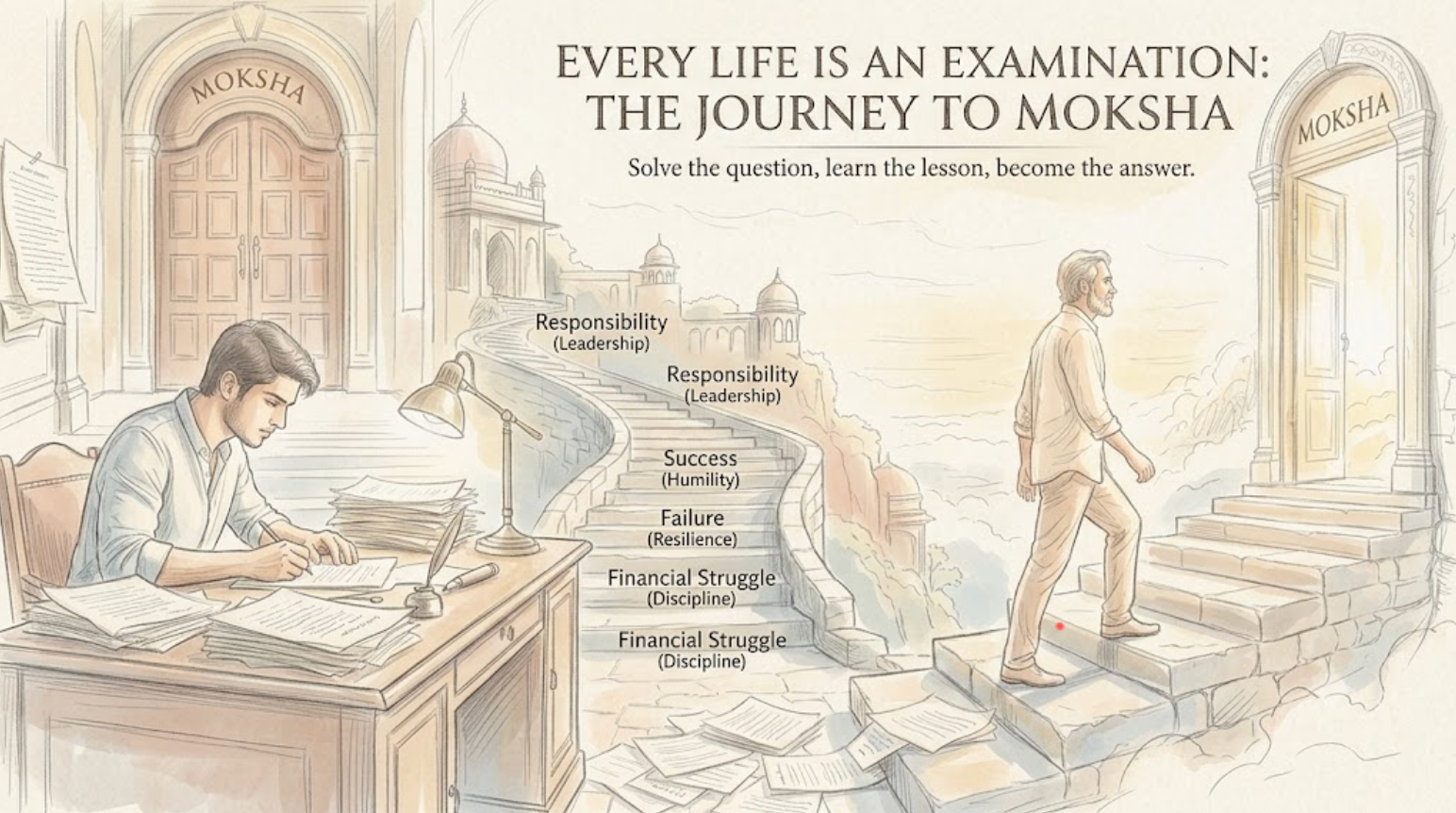
The business crisis may be preparing you for leadership.
The failure may be preparing you for resilience.
The financial struggle may be preparing you for discipline.
The difficult relationship may be preparing you for emotional maturity.
The responsibility may be preparing you for a bigger purpose.
The loss may be preparing you for acceptance.
The uncertainty may be preparing you for faith.
What looks like a problem from inside the examination hall may look completely different when you finally understand the lesson.
Perhaps one day you will look back and say:
“Now I understand why I had to go through that.”
And Then Comes the Final Moment
Imagine sitting before the final question paper.
You read the questions.
For the first time, you don’t panic.
You don’t complain.
You don’t look at someone else’s answer sheet.
You don’t ask why your paper is harder than somebody else’s.
You simply understand.
You write your answers.
You put down your pen.
And this time…
There is no next paper.
No next classroom.
No next examination.
The cycle is complete.
The student has graduated.
The soul is free.
Perhaps that is Moksha.
Until then, every morning we wake up with another question paper on our desk.
Some questions will be easy.
Some will be painful.
Some will make no sense.
Some will take years to solve.
Some may return again and again.
But perhaps the purpose is not to finish the paper quickly.
The purpose is to learn from every question.
So when life gives you a difficult question tomorrow, don’t immediately call it a problem.
Look at it differently.
Pick up your pen.
Read carefully.
Think deeply.
Solve honestly.
Learn completely.
And when you are ready…
Turn the page.
Because somewhere on the next page, another question may already be waiting.