


A career is not built by getting the first job. It is built by continuously adding value to yourself.
For a fresher, entering the professional world can be confusing.
There are thousands of courses, certifications, job portals, career options and opinions available today. Students often ask:
- Which job should I apply for?
- Which technology should I learn?
- Should I do an MBA, M.Tech or another certification?
- Is my degree enough?
- Why am I not getting shortlisted?
- How do I compete with candidates who already have experience?
These are important questions, but in my experience, the bigger question is:
What value can you create with what you already know, and what should you learn next to become more valuable?
That is where career coaching becomes meaningful.
My Approach to Career Coaching
Over the years, I have interacted with students and freshers who were trying to understand what they should do after completing their education.
My approach has never been to simply tell someone:
“Do this course and you will get a job.”
Instead, I try to understand the individual.
I look at their:
- Education and academic background
- Interests
- Existing technical and non-technical skills
- Communication abilities
- Problem-solving approach
- Strengths and areas of improvement
- Career interests
- Practical exposure
- Learning attitude
- Long-term aspirations
The objective is simple:
Identify where the student is today, understand where they want to go, and determine what value needs to be added between the two.
A Fresher Does Not Need to Know Everything
One of the biggest misconceptions among students is that they need to become experts before they can start their career.
That is rarely the case.
A fresher’s greatest advantage is the ability to learn, experiment and adapt.
Instead of asking:
“What job can I get?”
I encourage students to ask:
“What capability can I build that will make me useful to an organization?”
That change in thinking can completely change the way a student approaches a career.
A degree gives you an entry point.
Your skills, attitude, ability to learn and ability to solve problems create your professional value.
From Resume Building to Value Building
Resume preparation is important, but a resume should reflect capability rather than just qualifications.
For example, a student may write:
B.Tech in Computer Science
That tells us what the student studied.
But if the same student can demonstrate:
- A practical project
- Understanding of a business problem
- Programming capability
- Analytical thinking
- Communication skills
- Ability to work with a team
- Curiosity to learn new technologies
the conversation becomes completely different.
This is why I focus on value addition before resume decoration.
The resume should communicate the value the student can potentially bring to an organization.
Real Guidance Comes From Understanding the Individual
In my interactions with freshers, I have seen that two students with the same degree can have completely different career possibilities.
One may be highly analytical.
Another may be a strong communicator.
One may enjoy coding.
Another may be better at understanding customers and business processes.
Another may have strong leadership potential.
There is no single career formula that works for everyone.
The role of a career coach is not to make the decision for the student.
It is to help the student understand themselves better, understand the opportunities available, and make a more informed decision.
My Case-Based Approach With Freshers
When I guide a student, I generally start with questions rather than answers.
What do you enjoy doing?
What are you naturally good at?
What have you actually built or worked on?
What problems can you solve?
What do you want to learn?
What kind of environment do you want to work in?
What are your short-term expectations?
And perhaps most importantly:
What kind of professional do you want to become in the next 5–10 years?
Once these questions are understood, we can identify practical areas for value addition.
Sometimes it may be a technical skill.
Sometimes it may be communication.
Sometimes it may be project experience.
Sometimes it may be business understanding.
Sometimes the student simply needs direction and confidence to start.
I Believe Career Guidance Should Not Always Be About Money
One reason I have chosen to guide students is simple:
If my experience can help a young person avoid a wrong career decision or identify a better direction, that itself is valuable.
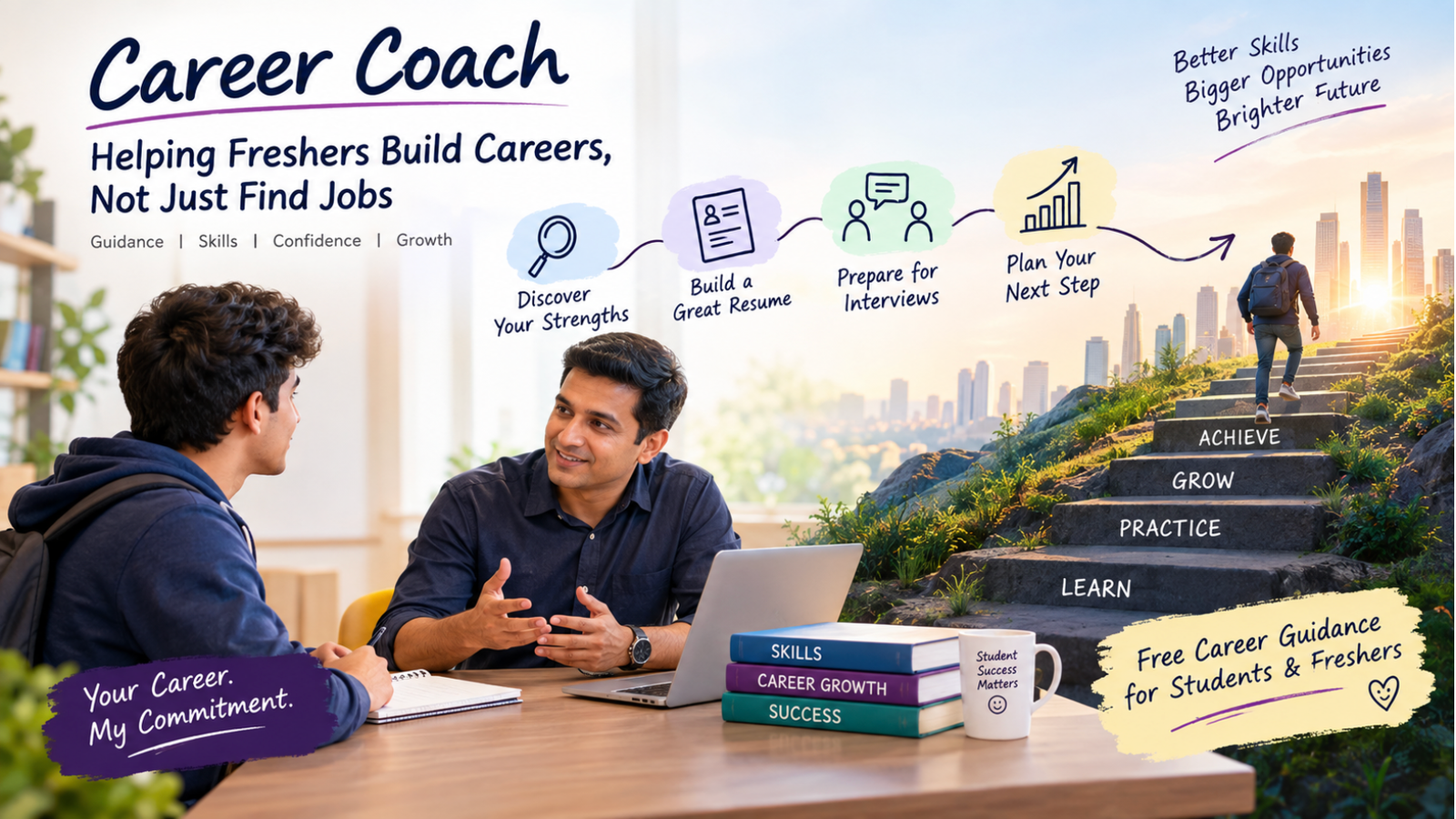
I have therefore been offering career guidance and coaching to students and freshers free of cost.
This is not about selling a course.
It is not about selling a certification.
It is not about promising a job.
It is about sharing practical experience and helping young people think more clearly about their careers.
My belief is simple:
Knowledge becomes more valuable when it creates value for someone else.
Career Coaching Is Not Job Placement
There is an important difference.
Job placement focuses primarily on getting someone into a job.
Career coaching focuses on helping someone understand:
Where they are → What they have → What they need → What they can become.
Job transitions, resume building and interview preparation are certainly part of career development.
But they are only pieces of a much bigger journey.
The real objective is long-term career progression.
For Parents: Don’t Choose the Career, Understand the Child
Parents naturally want the best for their children.
But sometimes, career decisions become influenced by what is popular, what relatives are doing, or which profession appears financially attractive.
A better approach is to understand the child’s:
Interest + Aptitude + Skills + Personality + Learning Ability + Opportunity
The right career is not necessarily the most popular career.
It is the career path where the individual has the potential to continuously learn, contribute and grow.
For Students: Start Adding Value Today
You don’t have to wait until you get your first job.
Start now.
Build something.
Solve a problem.
Learn a technology.
Understand a business.
Improve your communication.
Work on a project.
Participate in a competition.
Talk to professionals.
Ask questions.
Observe how businesses actually work.
Every small experience can become a building block for your professional identity.
Don’t wait for a company to give you experience. Start creating experience for yourself.
My Message to Every Fresher
Your first job is important.
But your first learning opportunity is even more important.
Don’t chase only a designation.
Don’t chase only a salary.
Don’t collect certificates without understanding their value.
Instead, build capabilities.
Because over time:
Capability creates confidence.
Confidence creates opportunity.
Opportunity creates experience.
Experience creates value.
And value creates career growth.
Free Career Guidance for Students
I believe experienced professionals have a responsibility to share what they have learned with the next generation.
If a conversation with me can help a student identify the right direction, understand their strengths, improve their skills or simply gain clarity about their next step, I am happy to contribute.
I offer career guidance and coaching to students and freshers without any consulting fee.
If you are a student, fresher or parent looking for a practical discussion about career direction, skills, value addition or professional growth, you can reach out to me.
Sometimes, one meaningful conversation can change the way you look at your career.
Let’s help the next generation build careers with clarity, capability and confidence. And this is not costing any charge! Helping new gen to fill the gap!
Gaurav Kumar
CEO | Open Business & Career Mentor (100% for social cause)
📧 gaurav.kumar@apagen.com
📱 +91-9971800665
Career is not just about getting a job.
It is about becoming valuable enough to create opportunities.