



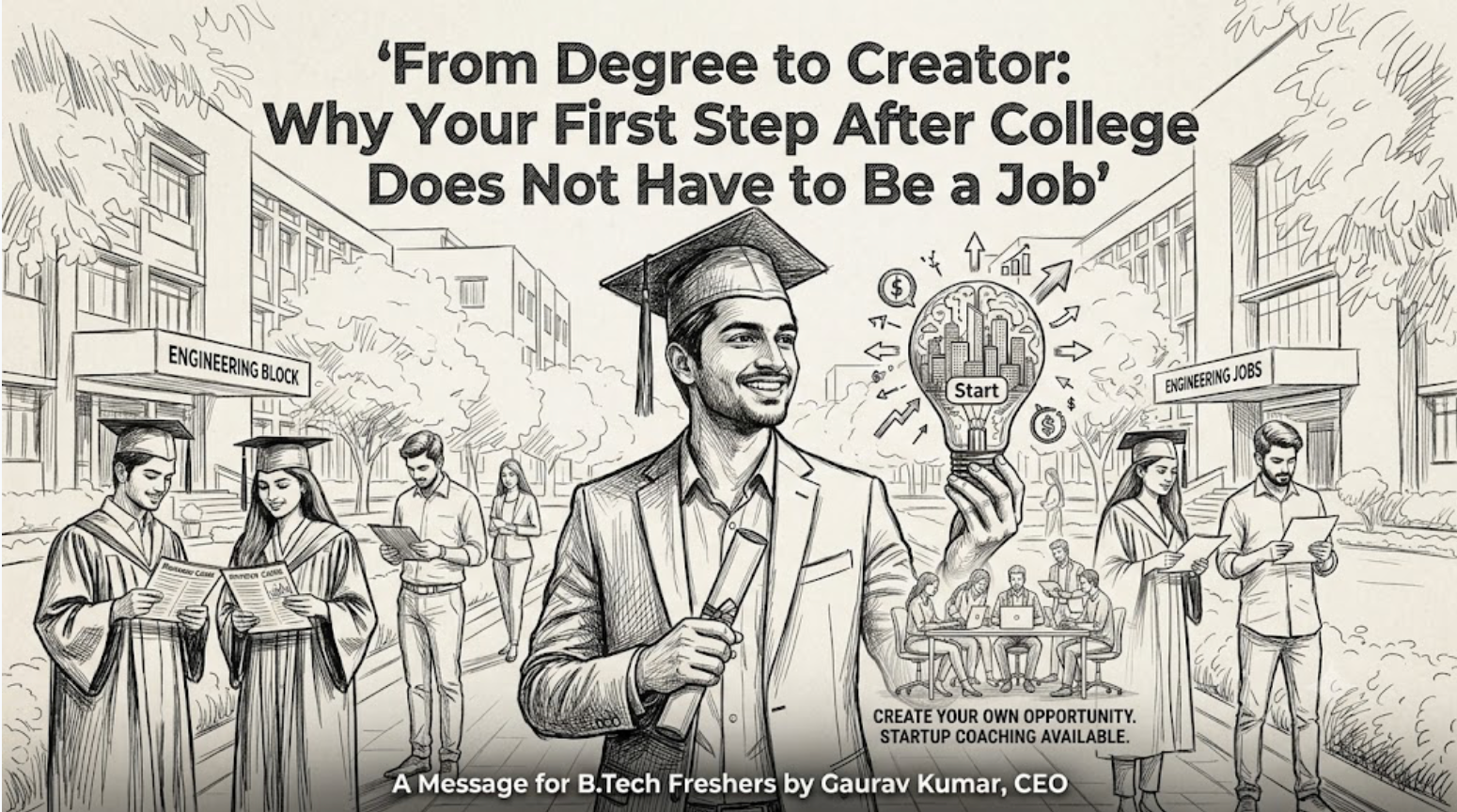
Why Your First Step After College Does Not Have to Be a Job
Every year, thousands of students graduate with the same question:
“Where will I get a job?”
A B.Tech degree is completed. The resume is prepared. Job portals are searched. Interviews are attended. Students wait for that one opportunity that will give them their first salary.
But what if there is another question worth asking?
“What if I can create an opportunity instead of only looking for one?”
This is not just a motivational thought.
It is something I have experienced in my own journey.
I Chose to Start Building Instead of Waiting
After completing college, I chose to start my own business journey rather than simply waiting for someone to give me a job.
That journey taught me something very important:
A degree can give you knowledge, but entrepreneurship requires you to convert knowledge into value.
Building a business is not about having everything figured out on Day 1.
It is about observing a problem, understanding a need, developing an idea, talking to people, learning from the market, making mistakes, improving your approach and continuing to move forward.
Over the years, my own business journey has given me more than professional experience.
It has taught me how to think about:
- Business opportunities
- Customer problems
- Sales and communication
- Strategy
- Execution
- Team building
- Business sustainability
- Learning from failure
- Converting ideas into action
And that is the experience I want to share with the next generation.
Job Seeker vs Job Giver
There is nothing wrong with getting a job.
A job can provide valuable experience, financial stability and professional exposure.
But I believe students should also understand that employment is not the only definition of career success.
A fresher can think differently.
Instead of asking only:
“Which company will hire me?”
Ask:
“Which problem can I solve?”
Instead of:
“What salary can I get?”
Ask:
“What value can I create?”
Instead of:
“Where can I find a job?”
Ask:
“Can I build something that eventually creates jobs for others?”
That change in thinking can completely change the direction of a career.
Your Branch Does Not Decide Your Business Potential
You may be studying:
- Computer Science
- Information Technology
- Mechanical Engineering
- Electrical Engineering
- Electronics
- Civil Engineering
- Chemical Engineering
- Biotechnology
- Or any other B.Tech branch
Your branch gives you a foundation.
But your ability to observe, think, learn and solve problems can take you much further.
A startup does not always begin with a revolutionary technology.
Sometimes it begins with a simple observation:
“There must be a better way to do this.”
That thought can become an idea.
The idea can become a small experiment.
The experiment can become a business.
And eventually, that business can create opportunities for other people.
Startup Does Not Always Mean Big Investment
One of the biggest misconceptions among young people is:
“I need a lot of money to start a business.”
Not necessarily.
Of course, some businesses require significant capital.
But many entrepreneurial journeys can begin with something much simpler:
Brain + Observation + Strategy + Execution.
You can start by identifying a problem.
You can talk to potential customers.
You can understand what they actually need.
You can create a small solution.
You can test it.
You can improve it.
You can find your first customer.
And then you can build step by step.
The first investment does not always have to be money.
Sometimes, the first investment is your thinking.
Entrepreneurship Is a Skill You Can Learn
You do not need to know everything before starting.
In fact, you probably won’t.
Entrepreneurship teaches you through experience.
You learn how to sell when someone says no.
You learn customer understanding when your first idea doesn’t work.
You learn financial discipline when resources are limited.
You learn leadership when other people start depending on you.
You learn strategy when competition appears.
And you learn resilience when things don’t go according to plan.
That is why I believe students should not be afraid of starting small.
Small beginnings can create big learning.
My Message to B.Tech Freshers
If you are currently pursuing B.Tech or have recently graduated, don’t limit your thinking to:
“I need a job.”
Think beyond that.
Ask yourself:
What am I good at?
What problems do I understand?
What problems do people around me face?
Can I solve one of those problems?
Will someone pay for that solution?
Can I start small?
Can I create value before I create a company?
You don’t have to become an entrepreneur overnight.
But you can start developing an entrepreneurial mindset today.
From Job Seeker to Job Creator
The real transformation begins in the mind.
A job seeker looks for an opportunity.
An entrepreneur looks for a problem worth solving.
A job seeker asks what the market can give them.
An entrepreneur asks what value they can bring to the market.
A job seeker may become an employee.
An entrepreneur may eventually become an employer.
Both paths are respectable. But students should know that they have a choice.
Complimentary Startup Coaching for Freshers
I want to make my own entrepreneurial experience available to young people who genuinely want to explore this path.
Therefore, I am offering complimentary startup coaching for freshers and students, particularly B.Tech students from any engineering branch.
This is not about selling a course.
It is not about asking you for an investment.
It is not about promising overnight success.
It is about having a conversation around your:
Idea → Problem → Opportunity → Strategy → Execution
If you have an idea but don’t know where to start, let’s discuss it.
If you have skills but don’t know how to convert them into an opportunity, let’s discuss it.
If you want to explore entrepreneurship instead of immediately becoming a job seeker, let’s discuss it.
Because sometimes, the biggest investment required to start thinking like an entrepreneur is not money.
It is the willingness to think differently.
Your Degree Can Be the Beginning, Not the Destination
Your college graduation does not have to be the end of your learning.
It can be the beginning of your journey.
You can join a company.
You can build a company.
You can work first and build later.
You can start small while learning.
There is no single formula.
But whatever path you choose, remember this:
Don’t just prepare yourself to get hired. Prepare yourself to create value.
And perhaps one day, instead of searching for your first job, you may be sitting across the table interviewing someone for the first job you created.
Want to Explore Your Startup Idea?
If you are a B.Tech student or fresher and have an idea you want to explore, I am happy to offer a complimentary startup coaching conversation.
No course fee.
No consulting fee.
No promise of shortcuts.
Just a practical conversation around your idea, your strengths, the opportunity and a possible strategy to start with zero investment.
Gaurav Kumar
CEO, Apagen Solutions Pvt. Ltd.
📧 gaurav.kumar@apagen.com
📱 +91-9971800665
Your first business may not need a big investment.
It may simply need you to start thinking like a creator instead of only a seeker.