



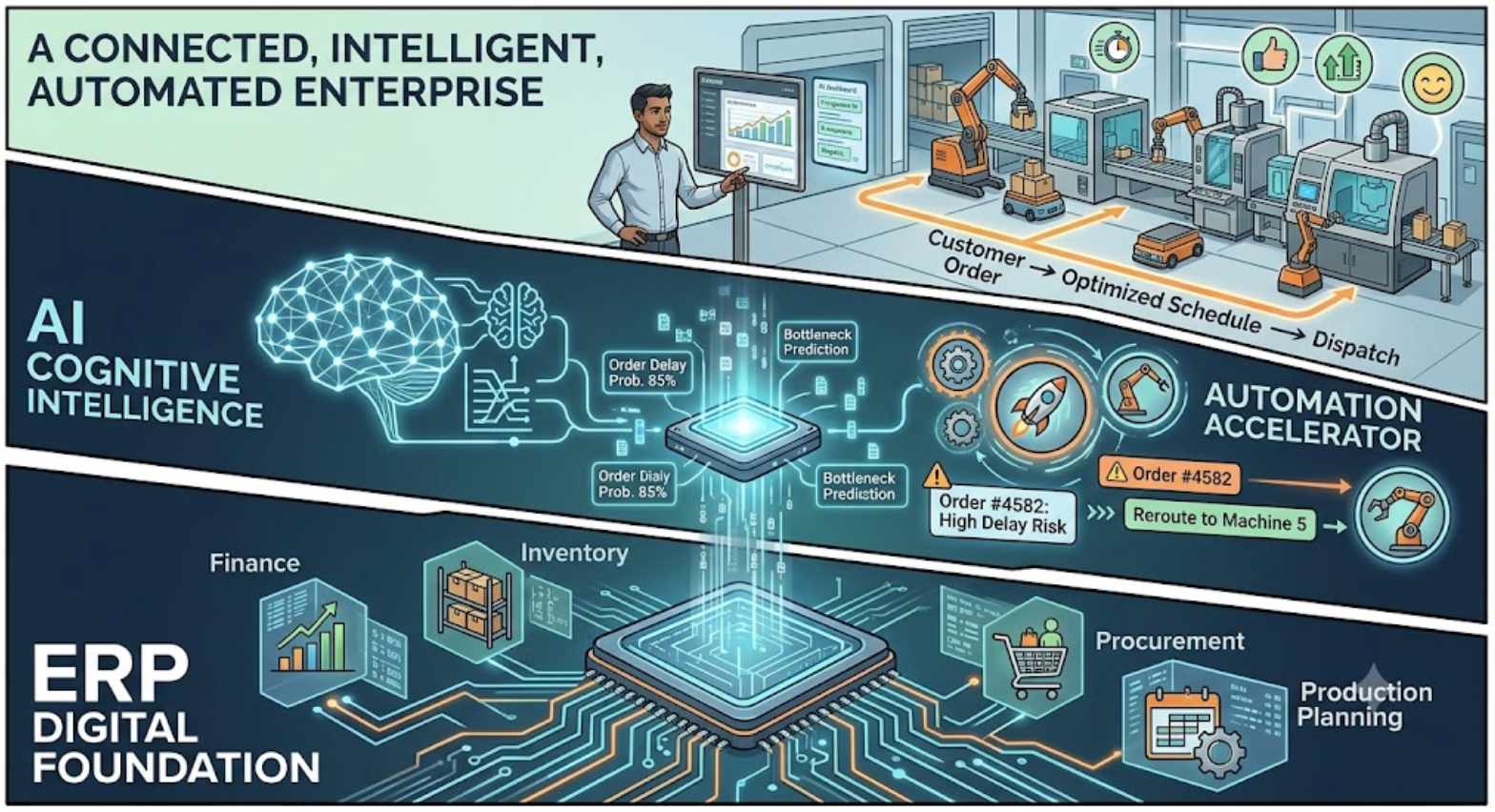
ERP Is the Foundation for AI Automation
It was 9:00 AM on a Monday morning.
Ravi, the Production Manager at a growing manufacturing company, was looking at the production floor.
Machines were running.
Workers were busy.
Orders were moving.
Everything appeared normal.
Then his phone rang.
It was the sales team.
“The customer wants the order two days earlier.”
Ravi looked at the production schedule.
Two days earlier?
That meant checking raw material availability, inventory, machine capacity, pending orders, manpower, procurement status, and dispatch plans.
And he knew what would happen next.
A few calls to the warehouse.
A message to purchase.
A discussion with production planning.
An update from sales.
And several hours later, he might finally have enough information to make a decision.
Ravi’s problem wasn’t that his people weren’t working hard.
His problem was that information was moving slower than the business needed it to.
The New Meaning of Production Speed
Manufacturing competition has changed.
Customers don’t only compare products on quality and price anymore.
They also compare how quickly suppliers can respond and deliver.
A company that can manufacture and deliver faster can respond to market demand more effectively.
But here’s the important question:
How do you make production faster without simply asking people and machines to work faster?
The answer begins with something much more fundamental:
Connected data.
And that’s where ERP comes in.
ERP: The Foundation Beneath the Factory
Ravi’s company implemented an ERP system.
At first, everyone thought of ERP as a system for managing finance, inventory, purchasing, production, and sales.
But over time, they realized something more important.
ERP was creating a single operational picture of the business.
Sales orders were connected to production.
Production was connected to inventory.
Inventory was connected to procurement.
Procurement was connected to suppliers.
Production schedules were connected to machines and resources.
Dispatch was connected to customer commitments.
For the first time, the company wasn’t operating through disconnected spreadsheets and isolated departmental information.
The business was becoming data-connected.
And this is where the story gets interesting.
Because ERP doesn’t only help humans make better decisions.
It can also provide the foundation on which AI automation can operate.
AI Needs More Than Intelligence
AI may be powerful.
But AI without reliable business data is like a brilliant employee who doesn’t have access to the company’s systems.
It may generate suggestions.
It may identify patterns.
It may predict demand.
But to automate real business processes, AI needs access to relevant and structured operational information.
Consider a simple example.
An AI system may be able to predict:
“This production order is likely to be delayed.”
That’s useful.
But what happens next?
Can it check the current inventory?
Can it see the production schedule?
Can it identify the missing material?
Can it check the purchase order?
Can it notify the responsible team?
Can it recommend a revised production schedule?
Can the business actually execute that recommendation?
This is where ERP becomes important.
ERP provides the operational foundation. AI provides intelligence on top of it.
From ERP Data to AI Automation
Imagine Ravi opening his dashboard one morning.
Instead of simply seeing a list of pending production orders, he sees an AI-generated alert:
“Order #4582 has a high probability of delay due to insufficient raw material and current machine capacity.”
Ravi clicks on the alert.
The system explains the reason.
The required material is short.
The supplier’s expected delivery date is tomorrow.
The machine required for the order already has two jobs scheduled.
The AI then suggests two possible production scenarios.
Ravi reviews the options and selects one.
The ERP system updates the relevant planning information.
Now imagine this happening across hundreds of orders.
That is where AI automation becomes powerful.
The objective isn’t simply to replace people.
It is to remove repetitive decision-making and manual coordination from their workload.
ERP + AI: From Reactive to Predictive
Traditional operations often work reactively.
A problem occurs.
Someone notices it.
Someone investigates it.
Someone makes a decision.
Someone communicates the decision.
Then the team takes action.
AI-enabled ERP can move organizations toward a more predictive approach.
Instead of waiting for a production delay, the system can identify patterns that indicate a potential delay.
Instead of waiting for inventory to become critically low, AI can analyze demand and inventory trends.
Instead of manually reviewing every production order, AI can highlight the orders that require attention.
Instead of employees spending hours preparing reports, AI can summarize operational performance and identify exceptions.
The workflow begins to change:
Monitor → Predict → Recommend → Automate → Act
But There Is a Catch
AI automation is only as reliable as the data and processes behind it.
If inventory data is inaccurate, AI may make the wrong recommendation.
If production data is incomplete, predictions may be unreliable.
If departments maintain different versions of the truth, automation becomes difficult.
That’s why simply adding an AI tool to an organization doesn’t automatically create an intelligent business.
The foundation matters.
And that foundation is often the ERP system.
The Factory of Tomorrow
Let’s return to Ravi.
A year earlier, Ravi spent much of his day asking:
“What’s happening?”
Now his ERP and AI tools increasingly help answer that question before he even asks.
Which orders are at risk?
Which materials may become critical?
Which machines are likely to become bottlenecks?
Which customers have changing demand patterns?
Which production schedules can be optimized?
Where is human intervention actually required?
Ravi’s role hasn’t disappeared.
It has changed.
Instead of spending his day collecting information and chasing updates, he can spend more time making decisions, solving exceptions, and improving the production process.
The Competitive Equation Is Changing
The manufacturing equation is no longer simply:
Quality + Cost = Competitiveness
Speed has become a critical part of the equation.
And increasingly, another factor is entering the picture:
Intelligence.
The modern manufacturing journey can therefore look something like this:
ERP → Connected Data → AI → Automation → Faster Decisions → Shorter Lead Times
ERP creates the digital foundation.
AI analyzes the information.
Automation turns insights into actions.
And people remain responsible for the decisions, oversight, and improvements that matter most.
The Real Goal Isn’t “More Technology”
The goal isn’t to have an ERP system because everyone else has one.
The goal isn’t to add AI because AI is trending.
The real goal is much simpler:
Reduce the time between a business need and the right business action.
A customer places an order.
The system understands the requirement.
Inventory is checked.
Production capacity is evaluated.
Potential constraints are identified.
AI recommends the best available action.
The relevant workflow is triggered.
And the team focuses on the exceptions that actually need human attention.
That’s the future of intelligent manufacturing.
The Final Lesson
Ravi’s company didn’t become faster simply because it purchased new technology.
It became faster because it built a connected operational foundation—and then used intelligence on top of it.
Because AI without business data has limited context.
And ERP without intelligence can still depend heavily on manual decisions.
Together, they can create something much more powerful:
A connected, intelligent, and increasingly automated enterprise.
The customer doesn’t care how many systems a company has.
The customer cares about one thing:
“Can you deliver what I need, when I need it?”
And in today’s competitive manufacturing environment, the companies that can answer that question faster will be the ones building the next generation of operations.
Less time in production is today’s competitive demand.
ERP is the foundation.
AI is the intelligence.
Automation is the accelerator.