

Healthy Lifestyle
A healthy lifestyle is not about completely avoiding carbohydrates or following extreme diets. It is about understanding what you eat, how your body processes it, and how your everyday food choices affect your long-term health.
The quality of carbohydrates matters just as much as the quantity.
Overview
Carbohydrates are one of the body’s primary sources of energy, but not all carbohydrates behave the same way in the body.
In this blog, we will understand:
- What are refined carbohydrates?
- What are complex carbohydrates?
- Common examples of both
- How each type is digested and used by the body
- How carbohydrates influence blood sugar and insulin
- How excessive refined carbohydrates can affect the liver
- The relationship between liver health, triglycerides, LDL and HDL cholesterol
- How choosing better carbohydrates can support a healthier diet
- Simple Indian recipes using dals, rajma and vegetables
- How to make healthy food practical and enjoyable
Refined Carbohydrates vs Complex Carbohydrates
What Are Refined Carbohydrates?
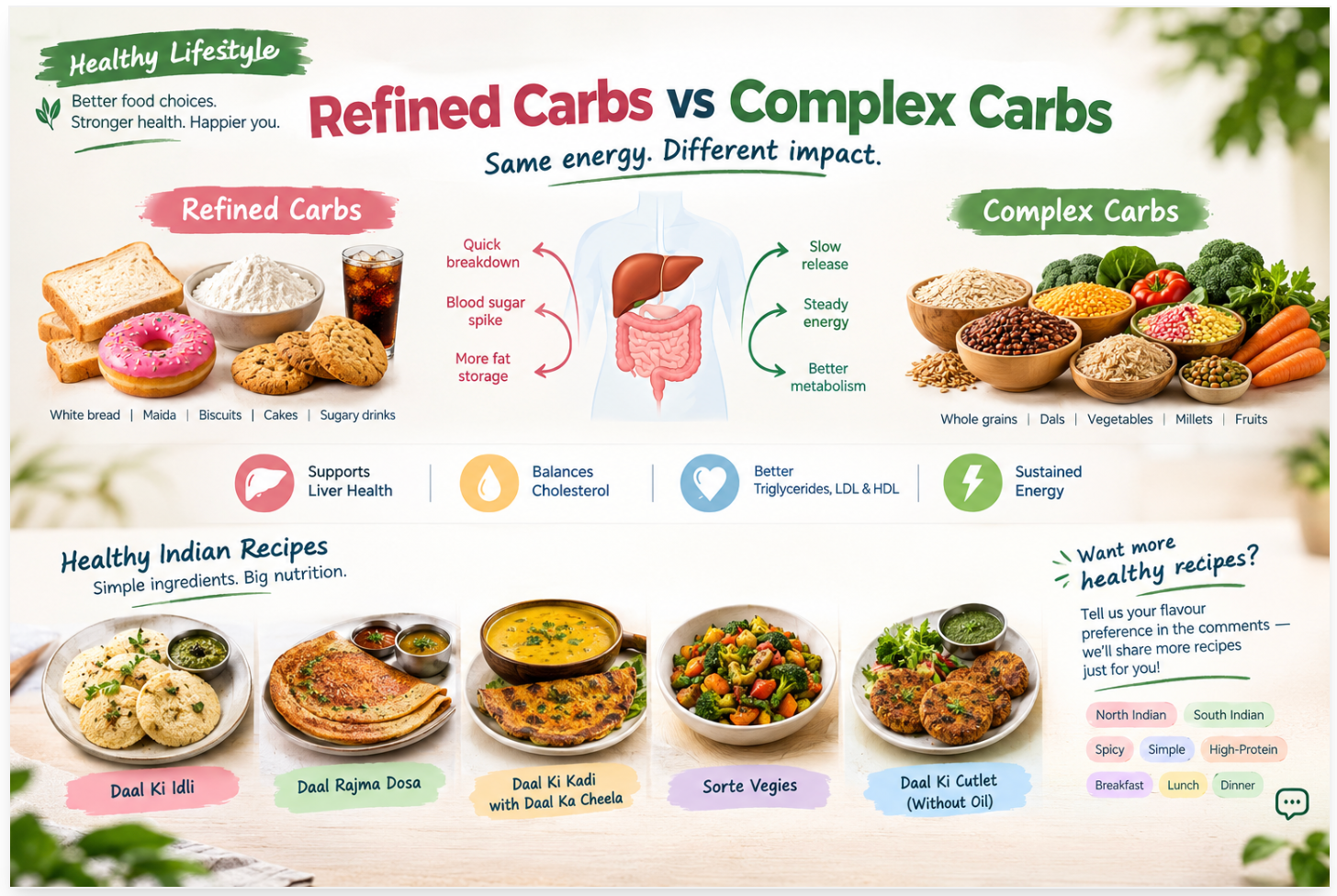
Refined carbohydrates are carbohydrates that have been processed to remove some of the naturally occurring fibre, vitamins and minerals.
Common examples include:
- Maida
- White bread
- Bakery products
- Biscuits
- Cakes and pastries
- Many packaged snacks
- Sugary cereals
- Sweetened drinks
- Foods made predominantly with refined flour
- Excessive intake of sugar and sweets
The important point is not simply that a food has been processed. The nutritional concern is that highly refined carbohydrate foods can be digested quickly and may provide a large amount of readily available carbohydrate with relatively little fibre.
What Are Complex Carbohydrates?
Complex carbohydrates generally come from foods that retain more of their natural structure and often provide fibre, vitamins, minerals and other nutrients.
Examples include:
- Whole grains
- Oats
- Millets
- Brown rice
- Whole wheat
- Dal
- Rajma
- Chana
- Other beans and legumes
- Vegetables
- Some whole fruits
Dal and legumes are particularly useful foods because they provide carbohydrates along with plant protein and fibre.
How Do They Work Inside Your Body?
When we eat carbohydrates, our digestive system breaks them down into smaller molecules, primarily glucose.
Glucose can then be used by cells as an energy source.
Refined Carbohydrates
A meal dominated by highly refined carbohydrates can be digested relatively quickly.
This can result in:
Refined carbohydrate → rapid digestion → faster rise in blood glucose → insulin response
The actual response depends on the food, portion size, combination with protein/fat/fibre, cooking method and the individual’s metabolic health.
Complex Carbohydrates
Foods containing more fibre and intact food structure generally take longer to digest.
The pathway can be more gradual:
Fibre-rich carbohydrate → slower digestion → more gradual glucose release → improved satiety
This is one reason why replacing highly refined foods with minimally processed, fibre-rich carbohydrate sources can be useful as part of a balanced diet.
What Happens to the Liver?
The liver plays a central role in carbohydrate and fat metabolism.
After carbohydrates are digested, glucose enters the bloodstream. Insulin helps move glucose into cells and regulates how the body stores and uses energy.
When the body has sufficient energy, the liver can convert excess carbohydrate into fat through de novo lipogenesis.
This becomes particularly relevant when the overall diet provides excessive calories, especially from foods and beverages high in added sugars and refined carbohydrates.
Over time, excess energy and metabolic dysfunction can contribute to fat accumulation in the liver.
This is why the conversation around carbohydrates should not simply be:
“Carbohydrates are bad?”
A more useful question is:
What type of carbohydrate are you eating, how much are you eating, and what is the overall quality of your diet?
Refined Carbs, Liver and Cholesterol
This is where the topic becomes particularly interesting.
Your liver is closely involved in the production and processing of lipoproteins and triglycerides.
A diet high in added sugars and refined carbohydrates, particularly when it contributes to excess calorie intake, can be associated with higher triglycerides and metabolic problems.
Triglycerides
Excess carbohydrate, particularly excess added sugar and refined carbohydrate in the context of excess energy intake, can contribute to increased triglyceride production.
LDL Cholesterol
LDL is commonly referred to as “bad cholesterol,” although LDL is actually a lipoprotein that transports cholesterol through the bloodstream.
Dietary patterns that improve overall metabolic health can influence LDL and other lipid markers, but the relationship is more complicated than simply:
Refined carbs = high LDL
Different dietary fats, fibre intake, body weight, genetics and overall dietary pattern also influence LDL.
HDL Cholesterol
HDL is often called “good cholesterol.”
However, simply increasing HDL is not the primary dietary goal. What matters is improving the overall cardiovascular risk profile, including LDL, triglycerides, blood pressure, blood glucose, physical activity and other factors.
So What Should We Eat?
Instead of asking:
“Should I stop eating carbohydrates?”
Try asking:
“Can I replace highly refined carbohydrates with fibre-rich, nutrient-dense carbohydrates?”
For example:
| Instead of | Consider |
|---|---|
| Maida-based snacks | Dal or whole-grain preparations |
| Sugary breakfast | Dal/legume-based breakfast |
| Biscuits | Roasted chana or nuts in appropriate portions |
| Refined-flour snacks | Vegetable + dal preparations |
| Sugary drinks | Water, unsweetened beverages |
| Highly processed snacks | Home-cooked whole-food options |
And healthy food does not have to be boring.
Here are some simple Indian options.
Healthy Indian Recipes
1. Daal Ki Idli
A simple way to turn dal into a protein- and fibre-containing breakfast.
Ingredients
- Moong dal
- Urad dal
- Optional vegetables
- Ginger
- Green chilli
- Cumin
- Salt
- Lemon/coriander
Method
- Soak the dal.
- Grind it into a smooth or slightly coarse batter.
- Add ginger, cumin, coriander and vegetables according to taste.
- Allow the batter to rest.
- Pour into idli moulds.
- Steam until cooked.
Why choose it?
Instead of starting the day with a refined-flour or sugary breakfast, this provides a combination of plant protein, carbohydrate and fibre.
2. Daal Rajma Dosa
A delicious combination of dal and rajma that can make a nutritious meal.
Ingredients
- Moong dal
- Masoor dal
- Rajma
- Ginger
- Green chilli
- Cumin
- Coriander
- Salt
- Vegetables of choice
Method
- Soak rajma separately and cook it properly.
- Soak the dals.
- Blend the dals and cooked rajma into a batter.
- Add spices and chopped vegetables.
- Heat a non-stick or well-seasoned tawa.
- Spread the batter into a thin dosa.
- Cook until properly done.
Tip: You don’t need to make the dosa oily. A good non-stick or seasoned tawa can help reduce the amount of oil required.
3. Daal Ki Kadhi With Daal Ka Cheela
A combination that can turn a traditional meal into a protein-rich option.
Daal Ki Kadhi
Use:
- Dal
- Curd
- Besan in a suitable quantity
- Turmeric
- Cumin
- Ginger
- Curry leaves
- Spices
Prepare the kadhi with minimal oil and avoid making the tempering unnecessarily heavy.
Daal Ka Cheela
Prepare a batter using soaked and blended dal.
Add:
- Onion
- Tomato
- Coriander
- Green chilli
- Ginger
- Cumin
- Vegetables according to taste
Cook the cheela on a non-stick or seasoned pan with little or no added oil.
Together, the dal-based kadhi + dal cheela can provide a satisfying combination of protein, carbohydrates and fibre.
4. Sautéed Vegetables
Vegetables can become the easiest way to increase fibre and micronutrients in your meals.
Ingredients
Choose whatever is available:
- Capsicum
- Beans
- Broccoli
- Carrot
- Cauliflower
- Cabbage
- Spinach
- Mushroom
- Zucchini
- Peas
Add:
- Garlic
- Ginger
- Black pepper
- Cumin
- Lemon
- Salt
Method
Use a small amount of oil and sauté the vegetables while keeping some texture.
The objective isn’t to drown vegetables in oil or sauces.
Keep the vegetables as the main ingredient.
5. Daal Cutlet Without Oil
Yes, you can make a tasty cutlet without deep frying.
Ingredients
- Cooked dal
- Boiled vegetables
- Carrot
- Beans
- Onion
- Coriander
- Green chilli
- Cumin
- Black pepper
- Salt
- Oats or roasted chana powder for binding
Method
- Cook the dal until soft but not excessively watery.
- Mix with finely chopped or mashed vegetables.
- Add spices.
- Add oats or roasted chana powder for binding.
- Shape into small cutlets.
- Cook on a good non-stick or air-fryer surface without adding oil, or use a minimal amount if needed.
- Cook until firm and lightly browned.
Serve with homemade mint/coriander chutney without added sugar.
The Bigger Lesson
Healthy eating doesn’t necessarily mean eliminating carbohydrates.
It means choosing carbohydrates intelligently.
A diet built around minimally processed foods, vegetables, legumes, adequate protein and appropriate portions can be much more sustainable than simply following a list of foods you are “not allowed” to eat.
And remember:
Dal is not just dal.
Rajma is not just rajma.
Vegetables are not just a side dish.
With the right preparation, ordinary Indian ingredients can become extremely versatile, nutritious meals.
Want More Healthy Recipes?
Tell us your flavour preference in the comments — North Indian, South Indian, spicy, simple, high-protein, breakfast, lunch or dinner — and we’ll share more healthy recipes around it.