

What if four simple things could quietly change the direction of your entire life?
Not money.
Not luck.
Not intelligence.
Not connections.
Just four things:
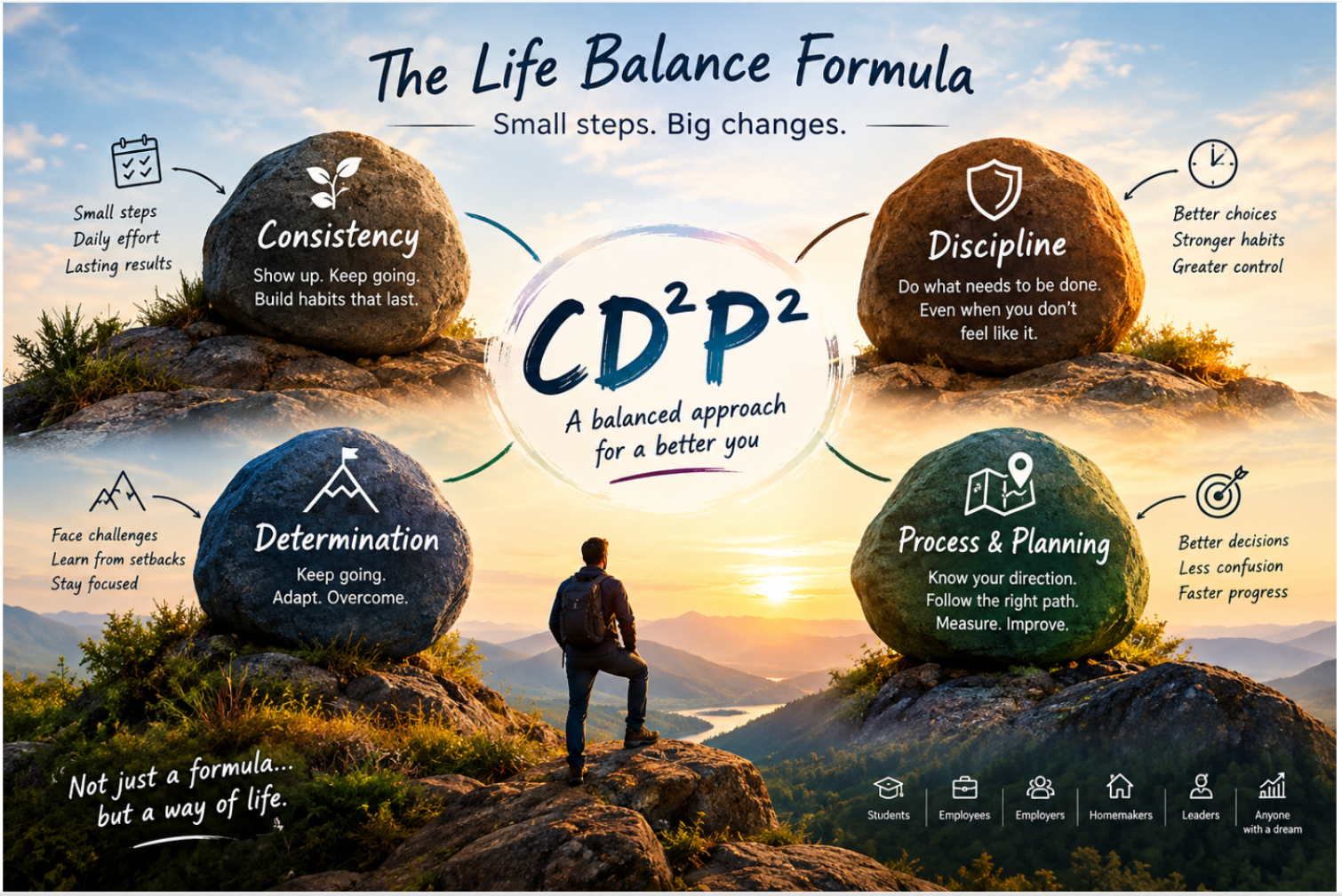
Consistency. Discipline. Determination. Process & Planning.
I call it CD²P².
And before you ask why these four things matter so much, let me tell you a story.
The Boy Who Wanted Everything
There was once a boy who had a simple dream.
He wanted to become successful.
He studied hard when exams were close.
He exercised when he felt motivated.
He worked on his ideas when inspiration came.
He made plans every New Year.
And every few months, he started something new.
A new habit.
A new goal.
A new strategy.
A new beginning.
But somehow, after some time, everything went back to where it started.
One evening, frustrated with himself, he asked an older man:
“Why do I start so many things, but finish so few?”
The old man smiled.
He picked up four small stones from the ground.
He placed the first one on the table.
“Consistency.”
The second.
“Discipline.”
The third.
“Determination.”
And then the fourth.
“Process and Planning.”
The boy looked at the stones.
“That’s it?”
The old man smiled again.
“That’s almost everything.”
The First Stone: Consistency
“Tell me,” the old man asked, “what happens if you study for ten hours today and then don’t study for the next ten days?”
“Not much,” the boy replied.
“And what happens if you study for one hour every day for ten days?”
The boy thought for a moment.
“Probably more.”
“Exactly.”
Success is rarely created by one extraordinary day.
It is created by ordinary days repeated extraordinarily well.
A student doesn’t become good because of one night of studying.
An employee doesn’t become valuable because of one brilliant presentation.
A business doesn’t become successful because of one good month.
A person doesn’t become healthy because of one workout.
Small actions become powerful when they become consistent.
Consistency turns effort into habit.
Habit turns into capability.
Capability turns into confidence.
And confidence eventually starts producing results.
But there is a problem.
Consistency becomes difficult when there is no discipline.
The old man placed the second stone beside the first.
The Second Stone: Discipline
“Motivation,” he said, “is a guest.”
“Discipline is a resident.”
The boy smiled.
That sentence stayed with him.
Because motivation is easy.
When you are excited, everything feels possible.
You wake up early.
You exercise.
You study.
You work.
You plan.
You dream.
But what happens on the day when you don’t feel like doing any of it?
That’s where discipline begins.
Discipline is doing what needs to be done even when your mood says otherwise.
A student studies when there is no exam tomorrow.
An employee completes the work even when nobody is watching.
An entrepreneur follows the process even after a bad month.
A homemaker manages responsibilities even when appreciation doesn’t come.
A leader continues to make decisions when the outcome is uncertain.
Discipline doesn’t ask:
“Do I feel like doing it?”
It asks:
“Does it need to be done?”
And that small difference can change an entire life.
But even disciplined people face failure.
That’s when the third stone becomes important.
The Third Stone: Determination
The old man picked up the third stone.
“Consistency tells you to continue.”
“Discipline tells you to do the work.”
“But determination tells you what to do when the work doesn’t give you the result you expected.”
Because life will test you.
You will fail.
Someone will reject you.
A business deal will disappear.
An exam result will disappoint you.
A promotion may not come.
A relationship may change.
A plan may fail.
Sometimes, despite doing everything right, things simply don’t work.
And that is where determination becomes different from motivation.
Determination is the decision to continue the journey even after the road changes.
It doesn’t mean blindly doing the same thing again and again.
It means being willing to change the approach without abandoning the destination.
The boy looked at the three stones.
“Then if I have consistency, discipline and determination, I will succeed?”
The old man laughed.
“Not necessarily.”
The boy was surprised.
“Then what is missing?”
The old man reached for the fourth stone.
The Fourth Stone: Process & Planning
“Imagine,” he said, “you are determined to reach a mountain.”
“You walk every day.”
“You never stop.”
“You are disciplined.”
“You are consistent.”
“But you never check the map.”
The boy immediately understood.
“You could be walking in the wrong direction.”
“Exactly.”
Hard work without direction can become wasted effort.
This is where process and planning enter the picture.
Planning tells you:
Where am I going?
Process tells you:
How will I get there?
Measurement tells you:
Am I moving in the right direction?
Review tells you:
What needs to change?
And improvement tells you:
How can I do it better tomorrow?
This applies everywhere.
A student needs a study plan.
A professional needs priorities.
A business needs processes.
A homemaker needs routines.
A leader needs systems.
A person working on personal growth needs goals, habits and a way to measure progress.
Without planning, effort can become scattered.
Without process, consistency can become repetitive.
Without review, discipline can keep you moving in the wrong direction.
Then the Old Man Did Something Unexpected
He took all four stones.
And instead of placing them in a straight line…
He placed them together.
Then he said:
“None of these is powerful enough by itself.”
Consistency without planning can mean repeatedly doing the wrong thing.
Planning without discipline can remain on paper.
Discipline without determination can collapse after repeated failure.
Determination without process can become endless struggle.
But when they work together…
Something changes.
Consistency + Discipline + Determination + Process & Planning
creates a balance.
That balance is what I call:
CD²P²
Not a mathematical formula.
A life formula.
The Interesting Part?
You don’t need to be a particular kind of person to use it.
You don’t need to be rich.
You don’t need to be highly educated.
You don’t need to be a CEO.
You don’t need to be exceptionally talented.
You don’t even need to know exactly where you will be five years from now.
You only need to understand your next step.
A student can use CD²P² to build learning habits.
An employee can use it to build professional capability.
An employer can use it to build a business.
An entrepreneur can use it to survive uncertain periods.
A homemaker can use it to bring structure and balance to everyday life.
A leader can use it to build people and systems.
A politician can use it to remain connected to people, commitments, processes and long-term objectives.
And anyone working on personal growth can use it to create balance between ambition and action.
The profession changes.
The circumstances change.
The goals change.
But the principles remain surprisingly similar.
But There Is One More Secret
The boy looked at the four stones.
“So, if I follow CD²P² every day, everything will become easy?”
The old man shook his head.
“No.”
“Then what does it give me?”
The old man looked at him and said:
“It doesn’t make life easy.
It makes you capable of handling life.”
That was the real lesson.
Because the purpose of consistency is not to make every day successful.
The purpose of discipline is not to remove every temptation.
The purpose of determination is not to prevent failure.
And the purpose of planning is not to guarantee the future.
They give you something much more valuable:
The ability to keep moving when life doesn’t go according to plan.
Life Is Not a Straight Line
We often imagine success like this:
Goal → Hard Work → Success
But real life rarely works that way.
It looks more like:
Goal → Plan → Action → Failure → Learning → Change → Action → Progress → Setback → Review → Improvement → Progress
And somewhere inside that journey, CD²P² keeps you balanced.
You plan.
You act.
You review.
You adjust.
You continue.
You grow.
Again.
And again.
And again.
The Four Questions
Perhaps the easiest way to remember CD²P² is to ask yourself four questions every day:
1. Consistency
Am I doing the right things regularly?
2. Discipline
Am I doing what needs to be done, even when I don’t feel like doing it?
3. Determination
When something goes wrong, am I willing to continue and adapt?
4. Process & Planning
Do I have a clear direction and a practical way to reach it?
If you can honestly answer these four questions, you may discover something interesting.
You don’t necessarily need to work harder.
Sometimes, you simply need to work more consistently, more consciously and more systematically.
And Perhaps That’s What Balance Really Means
Balance doesn’t mean giving equal time to everything.
Balance means giving the right attention to the right things at the right time.
Your career.
Your family.
Your health.
Your learning.
Your responsibilities.
Your ambitions.
Your relationships.
Your own growth.
Life will constantly pull you in different directions.
CD²P² doesn’t promise that you will never lose balance.
It gives you a framework to find your balance again.
The Four Stones Are Still There
Remember the boy?
Years later, he became successful.
But when someone asked him what changed his life, he never talked about one magical opportunity.
He talked about four stones.
One represented Consistency.
One represented Discipline.
One represented Determination.
And one represented Process & Planning.
Then he would say:
“I learned that success is not built by one big decision.
It is built by thousands of small decisions made in the right direction.”
And perhaps that is the real meaning of CD²P².
Because whether you are a student, an employee, an employer, a homemaker, a leader, an entrepreneur, a professional, or simply someone trying to become a better version of yourself…
the question is not whether you can do something extraordinary today.
The question is:
Can you do the right thing consistently, with discipline, determination, and a process that keeps you moving in the right direction?
Because one day, you may look back…
and realize that the life you built
was actually being built
one ordinary day at a time.
That is CD²P².