

The NIPA International Grey-Field ERP Transformation Story
There are ERP implementations where a company is starting from scratch.
And then there are ERP transformations where the company is already large, already successful, already running an enterprise ERP, and already has years of data, processes and users depending on it.
NIPA International was the second kind of story.
With a business turnover of more than ₹700 Crore, NIPA was already an established manufacturing organization. Its operations involved electrical and switchgear manufacturing, plastic injection moulding, tooling and several interconnected manufacturing activities.
And there was one important fact that made this project particularly interesting:
NIPA was already using Oracle.
So why change?
That was the question at the heart of the project.
When “We Already Have an ERP” Is Not the End of the Conversation
For a large manufacturing company, ERP becomes deeply embedded into the organization.
People know the system.
Processes are built around it.
Historical data sits inside it.
Reports depend on it.
Management decisions depend on the information coming from it.
Changing an ERP therefore means changing much more than software.
It means changing the way information moves through the organization.
For NIPA, the opportunity was to look beyond the existing ERP and ask a more fundamental question:
Can we create a more connected and business-oriented ERP environment for the next stage of our growth?
That question opened the door for Odoo.
This Was Not a Green-Field Implementation
One of the most important facts about the NIPA project is that it was a grey-field implementation.
We were not walking into an organization with no ERP.
We were walking into an organization with:
| Existing Reality | What It Meant for the Project |
|---|---|
| Existing Oracle ERP | The new ERP had to replace an established enterprise system |
| Existing users | User adoption and change management were critical |
| Existing processes | Processes had to be understood before redesign |
| Historical data | Migration and data quality were important |
| Manufacturing operations | Production dependencies had to be preserved |
| Existing reports | Business information requirements had to be understood |
| Established workflows | Odoo had to fit the business, not simply force generic workflows |
This is what makes grey-field ERP transformation different.
You cannot simply say:
“Let’s implement Odoo.”
You have to first understand:
“How does this business actually work?”
We Did Not Try to Build Oracle Again
This was one of the key principles of the transformation.
The objective was not to take every Oracle process and recreate it inside Odoo.
Instead, the team looked at the existing business processes and asked:
What is working?
What is creating friction?
What information is missing?
Where are departments dependent on manual coordination?
What should the future process look like?
The answer then became the basis for the Odoo solution.
That is the difference between ERP migration and ERP transformation.
Understanding the Manufacturing Chain
Consider a simple customer requirement.
A customer places an order.
Sales needs to know whether the product can be supplied.
That depends on inventory.
If the material is unavailable, Procurement becomes involved.
If the product needs to be manufactured, MRP becomes involved.
Production needs raw materials.
Tooling may be required.
Quality needs to verify the output.
Finished goods then become available for delivery.
One customer requirement can therefore touch multiple departments.
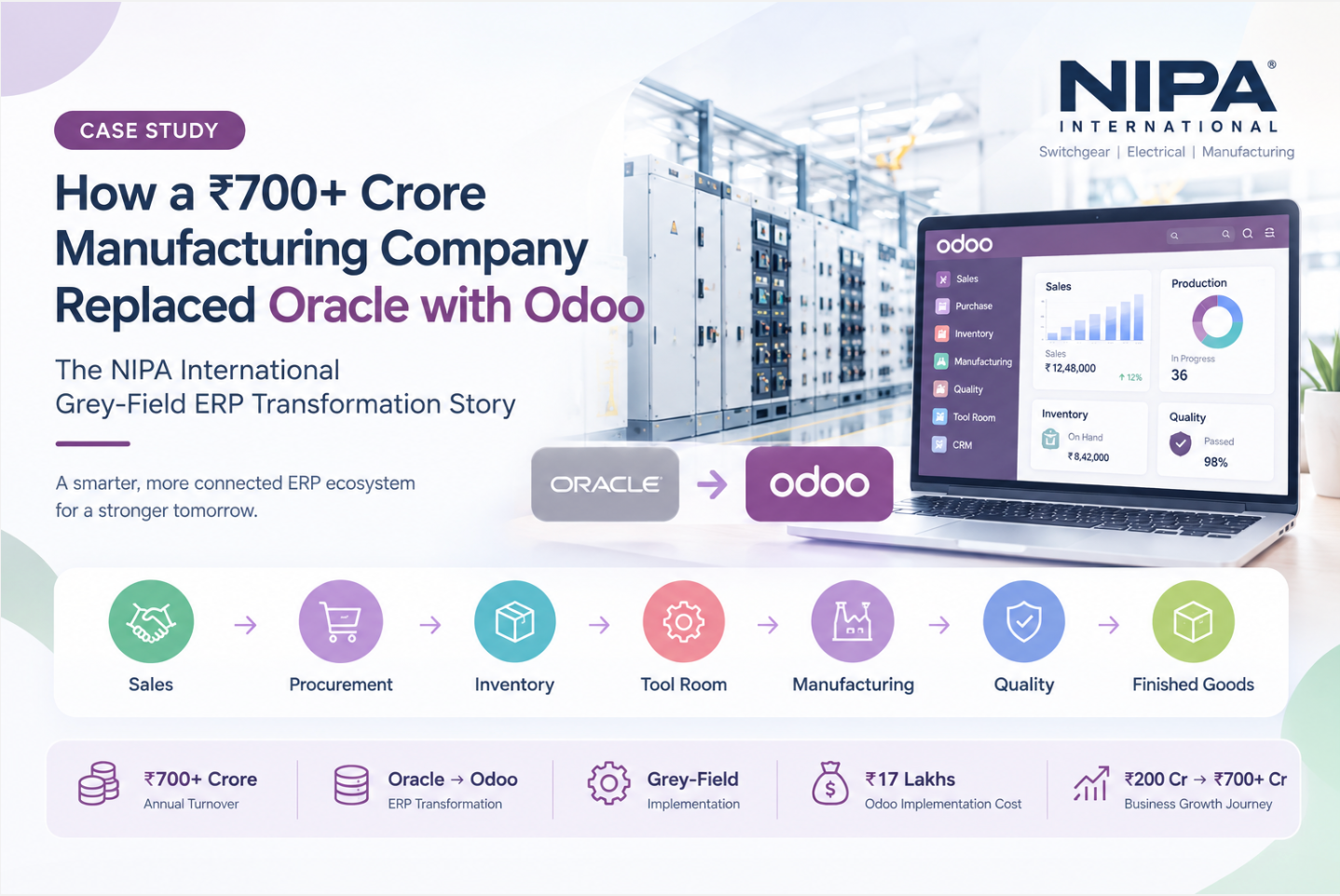
Sales → Procurement → Inventory → Tool Room → Manufacturing → Quality → Finished Goods
For a manufacturing enterprise, these cannot remain isolated islands.
The ERP has to understand the relationship between them.
That became a central part of the Odoo transformation at NIPA.
Odoo Became More Than an ERP Replacement
The implementation covered key business areas including:
| Business Area | Odoo Role |
|---|---|
| CRM | Opportunity and customer management |
| Sales | Quotations and sales orders |
| Purchase | Procurement management |
| Inventory | Material and stock management |
| Manufacturing | MRP and production processes |
| Tool Room | Integration with manufacturing requirements |
| Quality | Quality control and operational traceability |
| Management | Connected operational information |
The goal was not simply to put these modules into one system.
The goal was to connect the business processes behind them.
Why Tooling Mattered
In many ERP implementations, the Tool Room is treated as just another department.
In a manufacturing business, that can be a mistake.
Tooling can directly influence:
- Production capability
- Manufacturing timelines
- Product quality
- Material consumption
- Production planning
Therefore, connecting Tool Room operations with the broader manufacturing environment was an important part of creating a connected operational model.
The ₹17 Lakh Question
Now comes one of the most interesting facts of the NIPA story.
The Odoo implementation investment was approximately ₹17 Lakhs.
For a company with turnover exceeding ₹700 Crore, this creates an interesting perspective.
₹17 Lakhs is approximately 0.024% of ₹700 Crore annual turnover.
But this should not be presented as an “ROI of 4,117%” or any similar calculation.
Why?
Because turnover is revenue, not savings.
A genuine ROI calculation needs to consider the actual financial benefits generated by the project.
For example:
| ROI Driver | What Can Be Measured |
|---|---|
| ERP Cost | Oracle vs Odoo annual operating cost |
| Implementation Investment | ₹17 Lakhs |
| Inventory | Reduction in excess / slow-moving inventory |
| Procurement | Reduction in procurement inefficiencies |
| Production | Productivity and planning improvement |
| Reporting | Reduction in manual reporting effort |
| Manpower | Reduction in repetitive administrative work |
| Errors | Reduction in transaction and reconciliation errors |
| Management | Reduction in time required to obtain business information |
| Working Capital | Improvement resulting from better inventory and planning |
This is where the real ERP ROI should be calculated.
What Makes the NIPA Story Different?
The interesting part is not simply that Oracle was replaced by Odoo.
The interesting part is the scale and context.
A company with:
₹700+ Crore turnover
Complex manufacturing operations
Existing Oracle ERP
Existing users and processes
Multiple interconnected manufacturing functions
A grey-field implementation
Approximately ₹17 Lakhs Odoo implementation investment
chose to transform its ERP environment.
That makes the project a useful example of how Odoo can be considered beyond the traditional perception of a small-business ERP.
Growth and ERP: Keeping the Facts Straight
NIPA’s business journey also provides another important fact.
The organization grew from approximately ₹200 Crore to more than ₹700 Crore.
That is a substantial increase in business scale.
But it would be incorrect to say:
“Odoo increased NIPA’s turnover from ₹200 Crore to ₹700 Crore.”
Business growth has many causes: market opportunity, customers, products, manufacturing capability, leadership, people, execution and investment.
The more accurate conclusion is that Odoo formed part of the technology environment supporting the organization’s growth and operational requirements at a much larger scale.
That distinction matters.
A good case study should demonstrate impact without claiming what the data cannot prove.
From Oracle to Odoo: What Really Changed?
| Earlier Environment | Transformed Environment |
|---|---|
| Oracle ERP | Odoo ERP |
| Established legacy processes | Business-led TO-BE processes |
| Departmental information | Connected operational information |
| Separate functional dependencies | Integrated business flow |
| ERP as a transaction platform | ERP as an operating platform |
| Existing enterprise investment | New scalable ERP architecture |
The transformation was therefore not about replacing a brand.
It was about creating a technology environment better aligned with the business’s future requirements.
The Real ROI of ERP Is Not Always Visible on the Invoice
An ERP invoice tells you how much the software cost.
It does not tell you how much time management saved.
It does not tell you how much faster a production decision became.
It does not tell you how much manual reconciliation disappeared.
It does not tell you how much better inventory visibility became.
It does not tell you how much easier it became to connect Sales with Production.
And it certainly does not tell you what the business can do differently because information is available at the right time.
That is why ERP ROI needs to be viewed from both sides:
Financial ROI
Cost saved + measurable financial benefits
versus
Implementation + operating cost
Business ROI
Better information + better processes + better control + scalability + productivity
What NIPA Tells Us About Grey-Field ERP
The NIPA project reinforces a simple principle:
The biggest ERP opportunity often exists inside a business that already has an ERP.
Because an existing ERP gives you something extremely valuable:
experience.
You already know what works.
You already know what does not work.
You know where users struggle.
You know where information gets delayed.
You know where departments depend on spreadsheets.
You know where management needs better visibility.
A grey-field implementation allows the organization to use that experience to design the next ERP environment more intelligently.
The Apagen Approach
At Apagen, we did not look at NIPA as:
“An Oracle replacement project.”
We looked at it as:
A business transformation project enabled by Odoo.
Our approach was based on:
Business Understanding
↓
AS-IS Process Understanding
↓
Gap Identification
↓
TO-BE Process Design
↓
Odoo Fitment
↓
Implementation
↓
User Adoption
↓
Continuous Improvement
Because ERP success is ultimately not about how many modules are installed.
ERP success is about whether people can use the system to run the business better.
NIPA International: The Facts
| Fact | Details |
|---|---|
| Company | NIPA International |
| Industry | Electrical / Switchgear Manufacturing |
| Business Scale | ₹700+ Crore turnover |
| Previous ERP | Oracle |
| New ERP | Odoo |
| Project Type | Grey-Field ERP Implementation |
| Odoo Implementation Investment | ₹17 Lakhs |
| Key Functions. | Sales, CRM, Purchase, Inventory, MRP, Tool Room, Quality, R&D, Finance, HR, Dashboards and Reports for detailed Analysis |
| Manufacturing Environment | Electrical, Switchgear, Plastic Injection Moulding and Tooling |
| Growth Context | Approximately ₹200 Crore → ₹700+ Crore |
| Implementation Partner | Apagen Solutions Pvt. Ltd. |
The Final Lesson
The NIPA story is not really a story about Oracle.
And it is not really a story about Odoo.
It is a story about a growing manufacturing organization asking an important question:
“Is our ERP helping us become the business we want to become?”
When the answer requires change, ERP transformation becomes more than a technology project.
It becomes a business decision.
And sometimes, the most powerful transformation is not implementing ERP for the first time.
It is having the courage to replace the ERP you already have.
NIPA International did exactly that.
Oracle → Odoo
₹700+ Crore Manufacturing Enterprise
Grey-Field Transformation
₹17 Lakhs Implementation Investment
And a technology platform designed around the business, rather than the other way around.