

A business does not become scalable merely because it is growing. It becomes scalable when its people, processes, finances, assets and decisions start working together as a system.
Many businesses reach a stage where the founder or leadership team feels that the organisation is working, but cannot clearly answer some fundamental questions:
- Who is responsible for what?
- Which processes are actually documented?
- Which activities are generating business value?
- Where is money being lost or blocked?
- Are employees measured against meaningful outcomes?
- Which assets are underutilised?
- Is the strategy being executed or simply discussed?
- What information does management need to make better decisions?
This is where a Business Audit and Growth Framework becomes important.
It is not an audit limited to accounts, compliance or operational mistakes. It is a structured examination of the entire business system.
Business Audit Is More Than Finding Problems
A traditional audit often asks:
What is wrong?
A strategic business audit asks:
How is the business working, where is the gap, why does the gap exist, and what should change to create better business outcomes?
The objective is not to find fault with people.
The objective is to understand the relationship between:
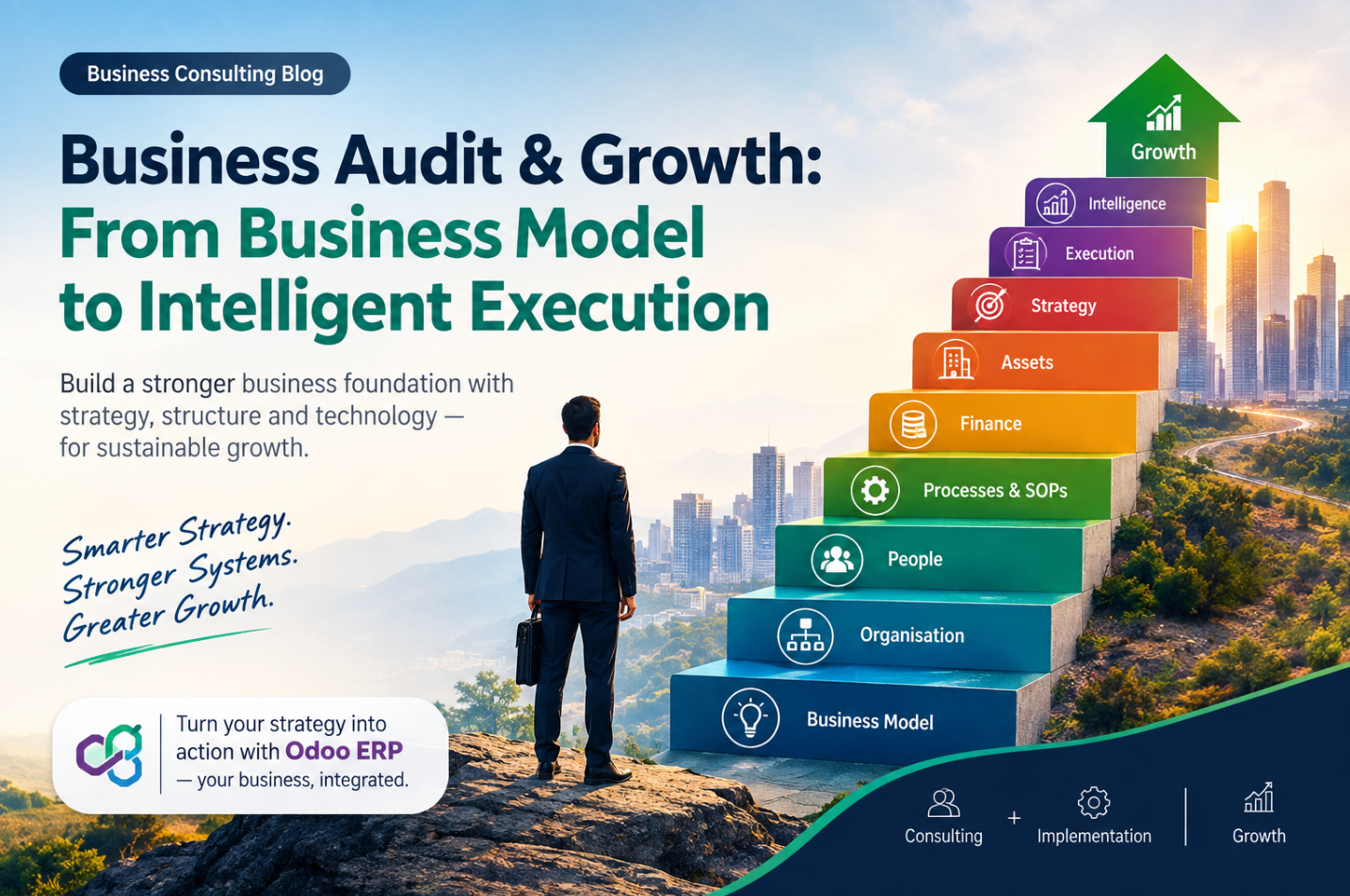
Business Model → Organisation → People → Processes → Finance → Assets → Strategy → Execution → Intelligence → Growth
When these elements are disconnected, growth creates complexity.
When they are connected, growth can create scale.
1. Start With the Business Model
Every business should periodically revisit its business model.
The Business Model Canvas provides a useful starting point:
- Customer Segments
- Value Proposition
- Channels
- Customer Relationships
- Revenue Streams
- Key Activities
- Key Resources
- Key Partners
- Cost Structure
But documenting these nine areas is only the beginning.
A proper business audit should examine:
Current State → Gap → Risk → Opportunity → Action
For example, a company may have a strong customer base but depend heavily on a few customers.
Another business may have good sales but weak project profitability.
Another may have capable employees but excessive dependency on individual people because processes have never been documented.
The business model therefore needs to be examined from both a strategic and operational perspective.
2. Map the Business Model With the Organisation
A business strategy cannot be executed by a business model canvas.
People execute it.
Therefore, the next step is to map the business model with the organisational structure.
Every major business responsibility should have:
Process Owner → Responsible Person → Accountability → KPI
The organisation chart should answer more than:
Who reports to whom?
It should answer:
Who owns which business outcome?
For example:
Lead Generation
→ Marketing
Opportunity Qualification
→ Sales
Requirement Understanding
→ Business Consultant / Business Analyst
Solution Delivery
→ Delivery Team
Customer Success
→ Account / Support Team
This creates an organisation based on business responsibilities, rather than simply job titles.
3. Convert Responsibilities Into KRA and KPI
A designation alone does not create accountability.
Accountability comes from clearly defined:
Role → Purpose → KRA → KPI → Target → Review
For example, the purpose of a Sales Manager is not simply “manage sales.”
The role may have KRAs around:
- Pipeline creation
- Qualified opportunities
- Conversion
- Revenue
- Customer acquisition
- Forecast accuracy
- Customer retention
Similarly, a Project Manager may have KRAs around:
- Delivery
- Timeline
- Budget
- Quality
- Resource utilisation
- Customer satisfaction
The objective is to ensure that individual performance contributes directly to organisational performance.
4. KRA Without SOP Creates Dependency on People
One of the biggest challenges in growing organisations is person dependency.
A person knows how something is done.
But the organisation does not.
That creates risk.
The solution is to convert important activities into documented processes.
A good SOP should define:
Input → Process → Decision → Output → Owner → SLA → KPI
For example, a sales process can be documented from:
Lead → Qualification → Requirement Discovery → Demo → Proposal → Negotiation → Closure → Handover
Once documented, management can identify:
- Bottlenecks
- Delays
- Duplicate activities
- Approval gaps
- Responsibility gaps
- Process leakage
- Automation opportunities
The objective of SOPs is not to create bureaucracy.
The objective is to create repeatability and scalability.
5. Finance Should Be Connected With Operations
Finance cannot be treated as a department that only closes books.
Management needs to understand the complete money cycle:
Lead → Order → Delivery → Invoice → Collection → Profit → Cash
A strategic business audit therefore examines:
- Revenue
- Gross margin
- Net margin
- Receivables
- Cash flow
- Customer profitability
- Project profitability
- Employee productivity
- Cost structure
- Recurring revenue
- Working capital
A company can have increasing revenue and still experience financial stress.
Therefore:
Revenue is a growth indicator. Profitability and cash flow determine the quality of that growth.
6. Audit the Assets of the Business
Business assets are not limited to machinery and buildings.
A modern organisation has several categories of assets.
Human Assets
Skills, experience, knowledge and leadership.
Physical Assets
Machines, equipment, infrastructure and facilities.
Technology Assets
Applications, systems, databases and digital infrastructure.
Intellectual Assets
Processes, documentation, intellectual property and know-how.
Customer Assets
Relationships, contracts, installed base and customer knowledge.
Every important asset should ultimately be evaluated through:
Cost → Utilisation → Contribution → Return
This changes the question from:
“What assets do we have?”
to:
“What value are our assets creating?”
7. Strategy Must Become an Execution System
Strategy often fails not because the strategy is wrong, but because execution is weak.
A strategic objective should therefore be converted into:
Objective → Initiative → Project → Action → Owner → Deadline → KPI → Result
For example:
Strategic Objective
Increase recurring revenue.
Initiative
Create a structured managed-service business.
Project
Design service packages and delivery processes.
Owner
Service Head.
KPI
Monthly recurring revenue.
Review
Monthly management review.
Now strategy is no longer a presentation.
It becomes an execution track.
8. Business Intelligence Should Support Decisions
Management information should not simply tell you what happened.
It should help answer:
What happened?
Revenue decreased by 8%.
Why did it happen?
New customer acquisition declined.
What is happening now?
The qualified pipeline is also declining.
What could happen next?
The next quarter may experience a revenue gap if pipeline creation does not improve.
What should management examine?
Marketing channels, sales activity, conversion and customer segments.
This is the difference between a reporting system and a management intelligence system.
The goal is to move from:
Data → Information → Insight → Decision → Action → Result
9. The Complete Business Audit Framework
A mature business audit can therefore connect ten dimensions:
| Dimension | Core Question |
|---|---|
| Business Model | How does the business create value? |
| Organisation | Who is responsible for the outcomes? |
| People | Are the right capabilities available? |
| KRA/KPI | How is performance measured? |
| Processes | How is work executed? |
| SOP | Can the process be repeated consistently? |
| Finance | Is the business financially healthy? |
| Assets | Are resources being utilised effectively? |
| Strategy | Where should the business go? |
| Execution & Intelligence | Are we executing and learning from the results? |
These should not operate as separate management exercises.
They should form one connected system.
From Business Audit to Business Operating System
The ultimate objective is to create a Business Operating System.
A system where:
Strategy defines the direction.
Organisation defines ownership.
KRA defines responsibility.
KPI defines measurement.
SOP defines execution.
Finance defines economic performance.
Assets define available capability.
Execution tracking defines progress.
Business intelligence defines what management needs to know.
And the continuous feedback loop becomes:
Measure → Understand → Decide → Execute → Review → Improve
That is how a business moves from founder-driven management toward a more structured and scalable organisation.
The Role of Technology
Technology should come after the business thinking, not before it.
An ERP should not be selected simply because a company needs accounting, inventory, CRM or HR software.
The more important question is:
Can technology become the operating layer that connects the business strategy with day-to-day execution?
When properly designed, an integrated business platform can connect:
Customers → Sales → Projects → Procurement → Inventory → Production → Finance → People → Management Reporting
The technology then becomes more than a transaction-processing system.
It becomes a source of organisational data, process discipline and management intelligence.
Your Business May Not Need More Software. It May Need More Structure.
Before implementing or changing an ERP, ask:
- Is our organisation clearly defined?
- Are responsibilities measurable?
- Are our critical processes documented?
- Do our SOPs reflect the way the business actually operates?
- Can we measure profitability at the right level?
- Do we know where resources are being underutilised?
- Can management see execution in real time?
- Are our strategic objectives connected to operational actions?
If the answer to several of these questions is “not yet”, the starting point should be business analysis and process design.
Technology should then reinforce that structure.
Let’s Audit Your Business Before We Digitise It
At Apagen, we approach ERP from a business and process perspective rather than treating ERP as simply a software implementation.
We can help you evaluate your:
Business Model → Organisation → People → Processes → KRA/KPI → Finance → Assets → Strategy → Execution → Business Intelligence
and identify where an integrated technology platform can improve control, visibility and scalability.
Where Odoo ERP is the right fit for the business, we can translate the business architecture into an integrated Odoo solution covering operations, finance, sales, projects, manufacturing, inventory, CRM and management reporting.
Don’t start with the question:
“Which ERP should we buy?”
Start with:
“How should our business operate?”
Then let technology support the answer.
Let’s evaluate your business together.
Apagen Solutions Pvt. Ltd.
Business Consulting + Odoo ERP Solutions
📧 gaurav.kumar@apagen.com
📱 +91-9971800665
🌐 Apagen.com