

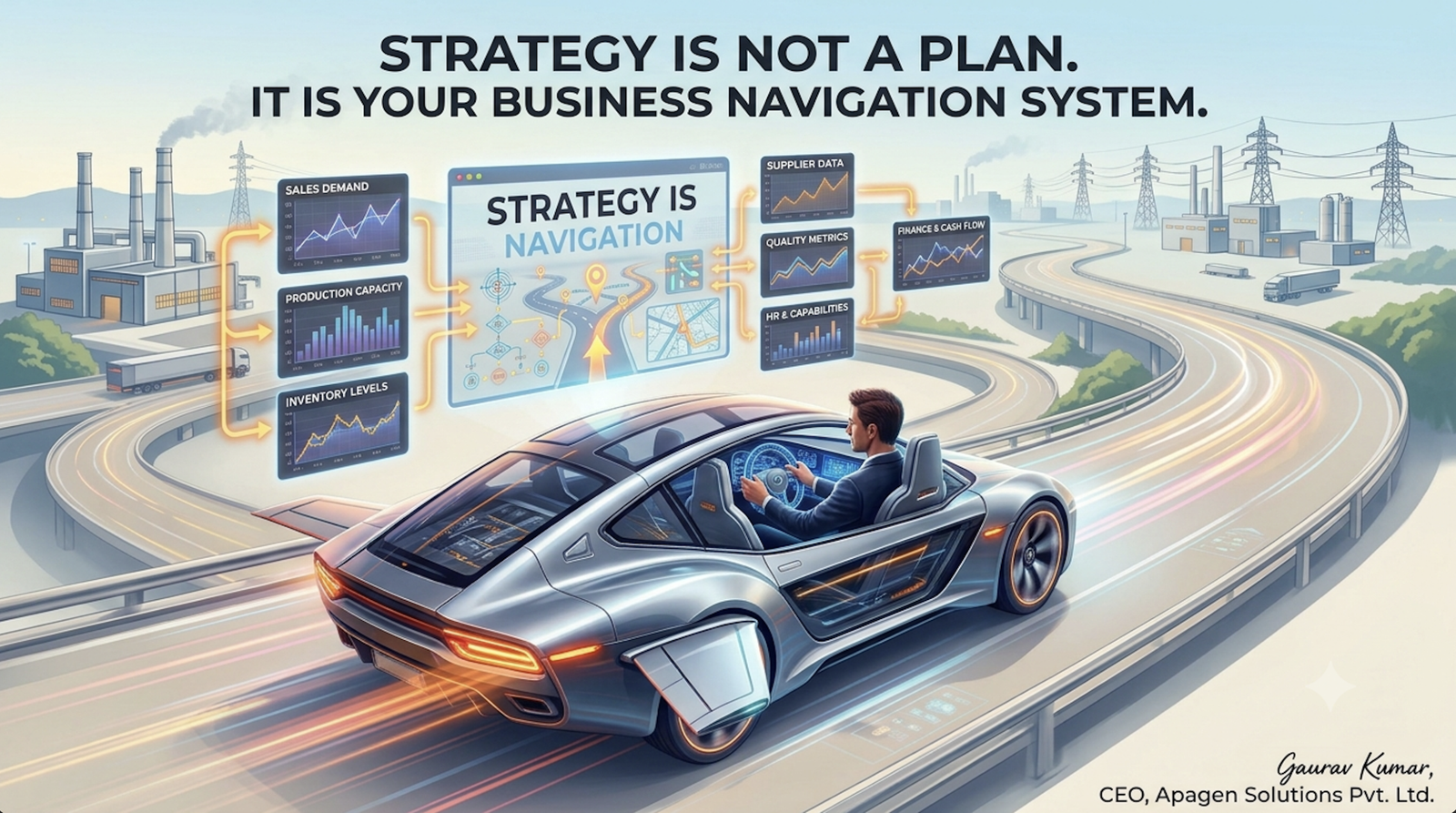
Strategy Is Not a Plan. It Is Your Business Navigation System.
Imagine you are driving a car on a long journey.
You know your destination.
You have a vehicle.
You have fuel.
You have a road.
But is that enough?
What happens when the road suddenly goes uphill?
What happens when traffic slows you down?
What happens when the road is blocked?
What happens when you miss a turn?
And what happens when you discover a faster route halfway through the journey?
You don’t throw away your destination.
You recalculate your route.
That is exactly what strategy should do for a business.
A business operates through ups, downs, uncertainty, competition, growth, slowdown and idle periods. The destination may remain the same, but the route may need to change.
This is why strategy should not be treated as an annual document sitting inside a management folder.
Strategy is navigation.
It tells you:
Where are we?
Where are we going?
What has changed?
What is blocking us?
What opportunity has appeared?
And what should we do next?
For a manufacturing company, this navigation becomes even more powerful because the business is not driven by one department.
It is an interconnected ecosystem.
Sales → Purchase → Inventory → Production → Quality → Delivery → Customer → Finance → People → Growth
A movement in one area creates a movement somewhere else.
And if management can see these movements quickly, it can build strategy quickly.
The Biggest Strategic Mistake: Looking at Departments Separately
Consider a manufacturing company.
Sales says:
“Orders are down.”
Production says:
“Capacity is available.”
Purchase says:
“Materials are already available.”
Inventory says:
“Stock is increasing.”
Finance says:
“Cash is tight.”
Management may initially see six different problems.
In reality, there may be one connected business story.
Demand has slowed.
Production has not adjusted.
Purchase has continued according to the old plan.
Inventory has accumulated.
Cash has become blocked.
Finance is now feeling the impact.
This is why strategy cannot be built by looking at departments independently.
A business is one system.
Every department is producing signals.
And those signals together tell management which direction the business is moving.
Every Department Is a Strategic Sensor
Think of your organisation as a large aircraft.
Sales is telling you about the market.
Production is telling you about your engine capacity.
Purchase is telling you about your fuel supply.
Inventory is telling you how much fuel and material you are carrying.
Quality is telling you whether the engine is functioning correctly.
Finance is telling you how much financial fuel you have.
HR is telling you whether you have the people required to fly the aircraft.
Maintenance is telling you whether your assets are ready for the journey.
And the CEO is sitting in the cockpit.
The CEO doesn’t need to become the salesperson, purchase manager, production manager or accountant.
But the CEO needs to see the signals coming from all of them.
That is strategic management.
Sales: “Is the Market Moving Towards Us or Away From Us?”
Sales is not just a revenue-generating department.
Sales is your market sensor.
Suppose your company normally receives ₹2 crore of orders every month.
Suddenly:
Month 1 → ₹1.9 Cr
Month 2 → ₹1.7 Cr
Month 3 → ₹1.5 Cr
The first question should not be:
“Why is the sales team not performing?”
The better strategic questions are:
Are customers reducing their purchases?
Is a particular industry slowing down?
Are competitors becoming more aggressive?
Has pricing changed?
Are customers moving towards another technology?
Is our product mix becoming outdated?
Is our delivery time hurting us?
Is our pipeline shrinking?
Now sales data has become strategy input.
The business may decide to:
enter a new segment, develop a new product, improve pricing, strengthen marketing, change the sales approach or deepen relationships with existing customers.
The important point is simple:
Sales tells you what the market is saying.
You just need to listen.
Production: “Can We Actually Deliver Our Growth?”
Now imagine the opposite situation.
Sales increases by 35%.
Everyone celebrates.
But production is already operating at 90% capacity.
Overtime is rising.
Machine breakdowns are increasing.
Quality rejection is increasing.
Delivery commitments are becoming difficult.
Suddenly, growth becomes pressure.
The strategic question changes from:
“How do we get more orders?”
to:
“How do we fulfil more orders profitably?”
Possible strategies could include:
- adding another shift,
- improving production planning,
- reducing machine setup time,
- outsourcing selected processes,
- purchasing new equipment,
- improving preventive maintenance,
- or prioritising high-margin orders.
The sales department created the opportunity.
Production determines whether the organisation can convert that opportunity into profitable growth.
Purchase: Your Strategy Can Be Destroyed Before Production Begins
Suppose your manufacturing company receives a large order.
But a critical imported component has a 90-day lead time.
Or a supplier suddenly increases prices by 15%.
Or a key supplier becomes unreliable.
The problem may appear in production later.
But the strategic signal appeared much earlier in purchase.
Purchase intelligence can help management decide:
Should we develop alternate suppliers?
Should we negotiate long-term contracts?
Should we increase safety stock?
Should we redesign the product around another component?
Should we pass cost increases to customers?
Purchase is therefore not merely about buying material.
Purchase protects the company’s ability to execute its strategy.
Inventory: Where Is Your Money Sleeping?
One of the most interesting strategic questions in manufacturing is:
How much of your money is sitting silently inside your warehouse?
Imagine:
₹3 Cr in raw material.
₹2 Cr in work-in-progress.
₹2 Cr in finished goods.
₹1 Cr in slow-moving stock.
Total inventory:
₹8 Cr.
Is ₹8 Cr good or bad?
The number alone cannot answer that.
Management needs to know:
How much is required for confirmed orders?
How much is excess?
How much is slow-moving?
How much is obsolete?
How much is tied to products whose demand is falling?
Now inventory becomes more than a warehouse report.
It becomes a working-capital strategy indicator.
Quality: When a Small Percentage Becomes a Big Strategy Problem
Suppose your rejection rate moves from:
2% → 3% → 4% → 5%
Five percent may look like a small number.
But imagine the company is producing ₹10 crore of goods every month.
That small percentage can translate into significant material loss, labour loss, machine time, rework, delayed deliveries and customer dissatisfaction.
More importantly, the increase may have a reason.
Perhaps:
A new supplier was introduced.
New operators joined.
Production targets increased.
Maintenance was delayed.
A process was changed.
A cheaper material was selected.
Quality therefore tells management more than:
“We have rejection.”
It can tell management:
“Something in our business model or execution has changed.”
That is strategy.
Maintenance: A Machine Breakdown Is Operational. Machine Dependency Is Strategic.
Imagine one machine produces 20% of your total output.
What happens if that machine stops for five days?
This is not just a maintenance problem.
It is a business continuity problem.
A strategic review should therefore ask:
- Which machines are business-critical?
- What is their utilisation?
- How often do they fail?
- What is the downtime cost?
- Do we have alternate capacity?
- Should we repair, replace, duplicate or outsource?
The objective is not simply to maintain machines.
The objective is to protect the company’s ability to execute its business strategy.
Finance: The Department That Tells You Whether Your Strategy Is Affordable
A company can have:
High sales.
Good production.
Strong orders.
Busy employees.
Full warehouses.
And still have a cash problem.
Why?
Because:
Profit is not the same as cash.
Suppose sales increase by 25%.
But receivables increase by 45%.
Inventory increases by 30%.
Supplier payments remain due.
The company is growing.
But cash is getting tighter.
This changes the strategy.
The business may need to focus on:
collections, customer credit, inventory reduction, margin improvement and cash conversion.
Therefore finance is not the department that simply closes the books.
Finance tells management whether the business can financially support its next move.
HR: Can Your People Carry Tomorrow’s Strategy?
Management decides:
“We will double production.”
Excellent.
But then someone asks:
Who will operate the machines?
Who will supervise?
Who will maintain them?
Who will manage quality?
Who will plan production?
Who will handle customers?
Who will implement the new process?
Suddenly the strategy meets reality.
This is why HR should not be measured only by headcount.
The strategic question is:
Do we have the capability required for where we want to go?
A company planning automation needs different skills from a company planning manpower-led expansion.
A company entering exports needs different capabilities from a company serving only domestic customers.
People strategy must therefore follow business strategy.
Now Connect Everything
This is where the real magic happens.
Imagine your dashboard shows:
Sales ↓ 15%
Production utilisation ↓ 20%
Inventory ↑ 18%
Receivables ↑ 25%
Purchase commitments ↑ 10%
Now look at these numbers together.
The story becomes obvious.
Demand is weakening.
Production has not adjusted sufficiently.
Inventory is accumulating.
Cash is getting blocked.
Purchase commitments may be adding more pressure.
This is not five departmental problems.
It is one strategic situation.
And management can act.
Stop unnecessary procurement.
Adjust production plans.
Focus sales on faster-moving products.
Accelerate collections.
Clear slow-moving inventory.
Review market positioning.
Use the available capacity for new products or new customers.
That is what a connected strategic review can do.
Strategy Changes With the Business Situation
A good strategy is not rigid.
The same company may need completely different strategies under different conditions.
When Business Is Growing
The questions become:
Can we scale?
Do we have enough capacity?
Can quality survive growth?
Can working capital support expansion?
Which customers and products should receive priority?
When Business Is Declining
The questions become:
Why is demand falling?
Which products are still growing?
Which customers remain profitable?
Where can we reduce structural costs?
How can we protect cash?
What capability should we build before recovery?
When Business Is Idle
This is where many companies lose a valuable opportunity.
An idle period does not always have to mean “wait.”
It can mean:
Prepare.
Clean your data.
Document your SOPs.
Train people.
Improve processes.
Automate repetitive work.
Develop new products.
Qualify alternate suppliers.
Improve preventive maintenance.
Build dashboards.
Review customer profitability.
Prepare for the next growth cycle.
Because when the market returns, the companies that prepared during the slowdown are not starting from zero.
They are already ready.
The 3-Speed Strategy Engine
The beauty of strategy is that it does not always require a long meeting.
You can create a simple review rhythm.
WEEKLY — “What Changed?”
Keep it fast.
30–60 minutes.
Look only at important movements.
Sales | Production | Inventory | Purchase | Quality | Receivables | Cash | Critical People Issues
The weekly question:
What changed, why did it change, and who needs to act?
MONTHLY — “What Is the Trend?”
Now zoom out.
Compare:
Actual vs Plan
Current Month vs Previous Month
Current Year vs Previous Year
Look for patterns.
The monthly question:
Is the business moving in the direction we expected?
ANNUAL — “Where Should We Go Next?”
Now step away from operations.
Look at:
Market
Products
Customers
Margins
Capacity
Technology
People
Capital
Competition
Opportunities
The annual question:
Does our current direction still make sense for the business we want to become?
The Strategy Formula
You can make the entire approach extremely simple:
WEEKLY
Detect
↓
MONTHLY
Understand
↓
QUARTERLY
Correct
↓
ANNUALLY
Redefine
This creates a continuous strategy cycle:
Observe → Understand → Decide → Execute → Measure → Recalculate
Just like navigation.
And This Is Where an Open-Source ERP Becomes More Than ERP
Most businesses think of ERP as a system for:
Invoices.
Purchase orders.
Stock.
Production.
Accounting.
Employees.
But there is another way to look at it.
ERP can become the business’s navigation infrastructure.
An open-source ERP available at zero licence cost can bring operational information into one connected environment.
Sales orders can connect with inventory.
Inventory can connect with purchase.
Purchase can connect with suppliers.
Production can connect with materials.
Production can connect with quality.
Employees can connect with activities.
Finance can connect with transactions.
Management can connect with all of it.
The value is not simply that information is stored.
The value is that information becomes visible at the right time.
And when information becomes visible quickly, decisions can become faster.
Don’t Ask Your ERP: “What Happened?”
Ask Better Questions.
A traditional ERP report might tell you:
Sales = ₹1.8 Cr
A strategic ERP environment should help management ask:
Why is sales ₹1.8 Cr instead of ₹2.2 Cr?
Which products declined?
Which customers declined?
Which salespeople have pipeline gaps?
Which regions are slowing?
What happened to margins?
What is likely to happen next?
Similarly:
Inventory = ₹7 Cr.
But management should ask:
Why ₹7 Cr?
Which inventory is required?
Which is excess?
Which is slow-moving?
Which is linked to confirmed orders?
Which is blocking cash?
That is the difference between:
Reporting
and
Strategic Intelligence.
The CEO’s Dashboard Should Tell a Story
A CEO should not need 50 reports to understand the business.
The dashboard should tell a story.
Something like:
MARKET
Are customers buying?
SALES
Are orders increasing?
PRODUCTION
Can we fulfil them?
MATERIAL
Do we have what we need?
QUALITY
Can we deliver consistently?
PEOPLE
Do we have the capability?
FINANCE
Can we afford the next move?
CASH
Can we sustain it?
STRATEGY
What should we do next?
That final question is the most important one.
The Real Power Is Not in the ERP
It is in the Review Discipline.
You can buy software.
You can create dashboards.
You can automate reports.
But if nobody reviews them, nothing changes.
The real transformation happens when the organisation creates a discipline:
Every Week → Review
Every Month → Analyse
Every Quarter → Correct
Every Year → Reposition
Now strategy becomes part of the operating system of the business.
Not a presentation.
Not a document.
Not a once-a-year exercise.
A habit.
Your Business Does Not Need to Predict the Future
No business can predict every market movement.
No CEO can know every turn in advance.
No strategy can guarantee that the road ahead will remain clear.
But a well-organised business can detect changes early.
It can see when demand is moving.
It can see when inventory is accumulating.
It can see when margins are shrinking.
It can see when machines are becoming bottlenecks.
It can see when cash is getting blocked.
It can see when people capabilities are insufficient.
And most importantly:
It can respond before the problem becomes a crisis.
That is the real meaning of strategy.
Strategy Is Navigation
Your destination may be:
₹10 Crore.
Or ₹100 Crore.
Or a new geography.
Or a new product line.
Or better profitability.
Or a more automated organisation.
The destination is your ambition.
But the market will keep changing.
So your route must keep adapting.
When business goes up — navigate growth.
When business goes down — navigate protection and correction.
When business becomes idle — navigate preparation.
When opportunity appears — navigate acceleration.
And when your departments are connected, your data is visible and your reviews happen consistently, strategy stops being something that management discusses occasionally.
Strategy becomes the way the business moves.
From Transactions to Navigation
An ERP should record what happened.
A better ERP environment should help you understand what is happening.
A strategically designed ERP environment should help management ask:
“What should we do next?”
That is where technology meets management.
That is where operational data becomes business intelligence.
And that is where an open-source ERP with zero licence cost can become more than a software investment.
It can become the foundation for a weekly, monthly and annual business navigation system.
Your business does not need more reports.
Your business needs better visibility.
Better visibility creates better decisions.
Better decisions create better execution.
Better execution creates better business.
Strategy is navigation.
Make sure your business has a map, a compass and the visibility to recalculate the route.
Let’s Evaluate Your Business Navigation System
At Apagen, we look at ERP from a business perspective, not simply as software implementation.
We help businesses connect their people, processes, SOPs, KRA/KPIs, finance, assets and operational data so that management can build a more structured review and execution system.
The objective is simple:
Don’t wait for the annual review to discover what happened last year.
Build a business that can see what is happening this week, understand the trend this month, and continuously reshape its direction every year.
Let’s evaluate your business together.
Gaurav Kumar
CEO, Apagen Solutions Pvt. Ltd.
Business & ERP Strategy Consultant
17+ Years of Business Experience
Apagen
gaurav.kumar@apagen.com | +91-9971800665